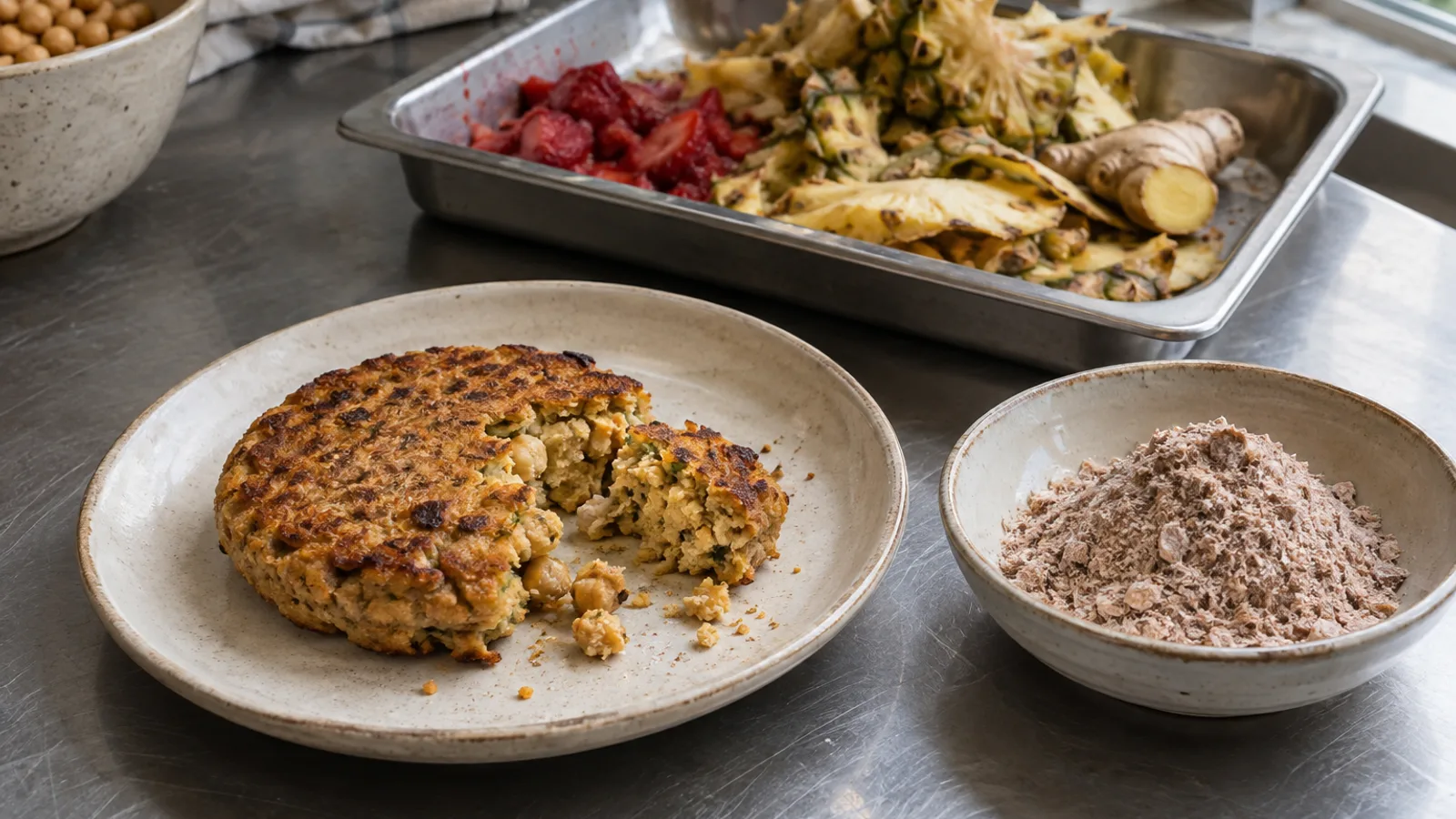
A mixed juice-processing residue becomes flour
Researchers at Brazil’s Federal University of Rio Grande do Sul studied flour made from strawberry, pineapple and ginger juice-processing residues. Their Journal of Food Science paper, published on 6 August 2026, used a residue blend supplied by one local juice producer.
The flour contained 35.76 ± 1.40 g of total dietary fibre per 100 g on a dry-matter basis. The measured insoluble and soluble fractions were 27.32 ± 1.80 g and 8.44 ± 0.41 g per 100 g, respectively.
Three formulations compared
The team developed a control chickpea burger, H0, and two residue-flour formulations, H10 and H15. Residue flour replaced the oat and brown-flaxseed flours used in the control; H15 also used less buckwheat flour than H0 and H10.
The authors explicitly describe the results as comparisons among formulations rather than the isolated effect of adding residue flour. The H10 and H15 designations follow the study’s flour-substitution formulations.
Lower hardness in the instrumental test
After cooking, instrumental hardness averaged 58.54 ± 4.80 N for H0, 52.57 ± 2.13 N for H10 and 42.16 ± 2.40 N for H15. Table 6 assigns different statistical groups to all three hardness means under the reported Tukey test at p < 0.05.
The same table reports no statistically significant differences among formulations for cohesiveness, springiness, gumminess or chewiness.
Composition measurements and the authors’ next steps
For the burgers, the team measured moisture and ash and calculated lipid, protein, dietary-fibre and energy values from ingredient-composition information. Table 5 states that inferential statistical analysis was not applied to its mixture of measured and calculated results.
The sensory comparison included H10 and H15. The authors call for future sensory trials to include a control formulation, and for further work on the stability of bioactive compounds and their antioxidant capacity after thermal processing.
Source and adaptation
Letícia da Cunha Espinosa, Tainara de Moraes Crizel, Paola de Souza, Giovanna Ribeiro Varesano, Aldrey Nathália Ribeiro Corrêa, Cecília Roratto Köhn, Adriano Brandelli, Simone Hickmann Flôres and Alessandro de Oliveira Rios. Upcycling of Mixed Fruit Juice By-Products for Flour Production and Application in Plant-Based Burgers. Journal of Food Science, 6 August 2026. DOI: 10.1111/1750-3841.71331. © 2026 The Authors. CC BY 4.0. Independently rewritten by FoodRadar; translations prepared manually.
-
Upcycling of Mixed Fruit Juice By‐Products for Flour Production and Application in Plant‐Based Burgers ↗
Journal of Food Science · CC-BY-4.0 ↗. Letícia da Cunha Espinosa, Tainara de Moraes Crizel, Paola de Souza, Giovanna Ribeiro Varesano, Aldrey Nathália Ribeiro Corrêa, Cecília Roratto Köhn, Adriano Brandelli, Simone Hickmann Flôres and Alessandro de Oliveira Rios (2026). Upcycling of Mixed Fruit Juice By-Products for Flour Production and Application in Plant-Based Burgers. Journal of Food Science, 6 August 2026. DOI: 10.1111/1750-3841.71331. © 2026 The Authors. CC BY 4.0. Editorial adaptation and manual translations: FoodRadar. Adapted by FoodRadar.