Three factors accounted for most main-barrier responses
High price, lack of preparation knowledge and lack of time accounted for 79.0% of responses to a question about the main barrier to consuming Andean foods in a Peruvian survey. The study, published in Foods on 20 September 2026, used responses collected online in 2024 from 1,074 adults. High price was selected by 30.7%, preparation knowledge by 26.9% and time by 21.4%.
Participants were recruited through convenience sampling. They had to be Peruvian adults living in Peru who had consumed Andean grains within the preceding six months. The sample consisted predominantly of young people affiliated with universities; 81.2% were aged 25 or younger. The authors state that the findings cannot be generalised to the entire Peruvian population.
Quinoa was the most frequently selected food
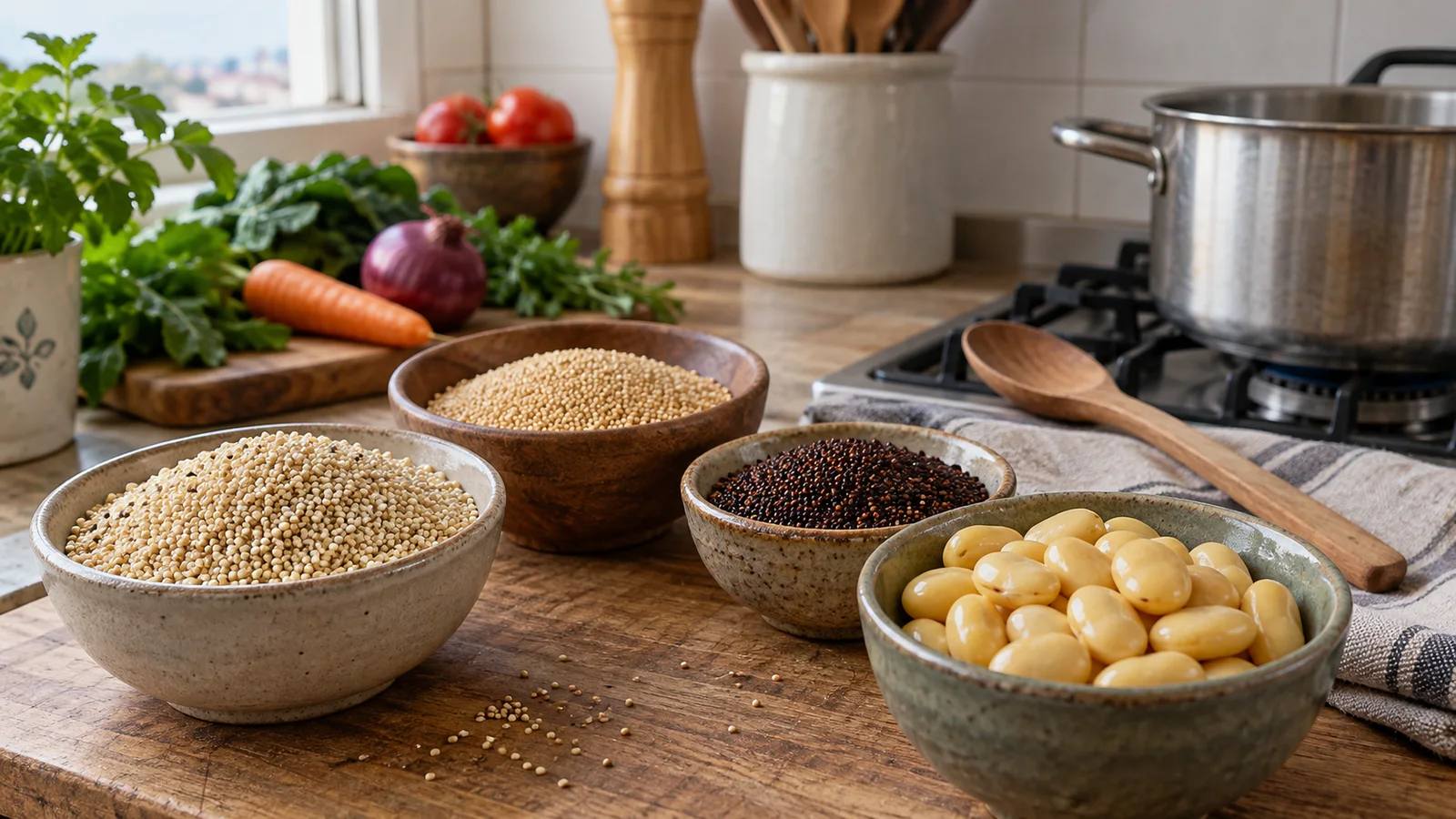
When asked which Andean grains they usually consumed, 79.3% selected quinoa, 47.0% kiwicha, 31.1% cañihua and 7.9% tarwi. All 1,074 respondents were included in this analysis. They could select more than one food, so the percentages do not add up to 100%.
Occasional purchasing was reported by 47.0% of respondents, while 27.9% selected always or almost always. Local markets were the usual purchase channel for 36.4%, followed by stores near home at 22.3%. Together, these two channels accounted for 58.7% of reported purchase preferences.
Purchase reasons allowed several answers; the barrier question allowed one
Among 1,065 valid responses to the purchase-reasons question, 63.6% selected nutritional value and 46.2% naturalness. The separate consumption-motivations question had 1,071 valid responses: 56.9% selected that the foods were nutritious, 56.7% that they were healthy and 21.8% that they were part of their culture. Both questions allowed multiple answers. Invalid responses were excluded from the relevant analysis rather than from the entire study.
The main-barrier question allowed one answer per respondent. Of the 1,074 participants, 330 selected price, 289 preparation knowledge and 230 lack of time. Difficulty accessing the products accounted for 13.0% of responses and dislike of the taste for 7.9%. The authors note that sensory acceptability was not formally assessed.
Regional associations and limits of the survey
The study compared respondents by self-reported region of origin: the Andean highlands, the urban-coastal region and the Amazonian region. The share reporting always or almost always purchasing these foods was 37.3% in the Andean group and 21.2% in the urban-coastal group. The authors used origin as a geographic proxy for proximity to Andean food-production traditions; it was not a psychological measure of cultural identity.
The authors identify convenience sampling, the cross-sectional design and self-reported behaviour as limitations. The design does not establish causal relationships, and responses may be affected by social desirability. They also note that the six-month eligibility criterion and questions about usual frequency used different reference periods: the latter had no fixed time frame. This could explain why some eligible participants still selected never on the frequency questions.
-
Consumer Behavior Toward Andean Grains Among Young Peruvian Adults: Purchase Patterns, Motivations, and Barriers Across Cultural Contexts ↗
Foods · CC-BY-4.0 ↗. Dany Yudet Millones-Liza, Elizabeth Emperatriz García-Salirrosas, Manuel Escobar-Farfán, Iván Veas-González, Manuel Amasifuen-Reategui and Esther Olivia Acosta-Miraval (2026). Consumer Behavior Toward Andean Grains Among Young Peruvian Adults: Purchase Patterns, Motivations, and Barriers Across Cultural Contexts. Foods 15(18),3341,published 20 September 2026. DOI:10.3390/foods15183341. Copyright 2026 by the authors. CC BY 4.0. Editorial adaptation and translation: FoodRadar. Adapted by FoodRadar.