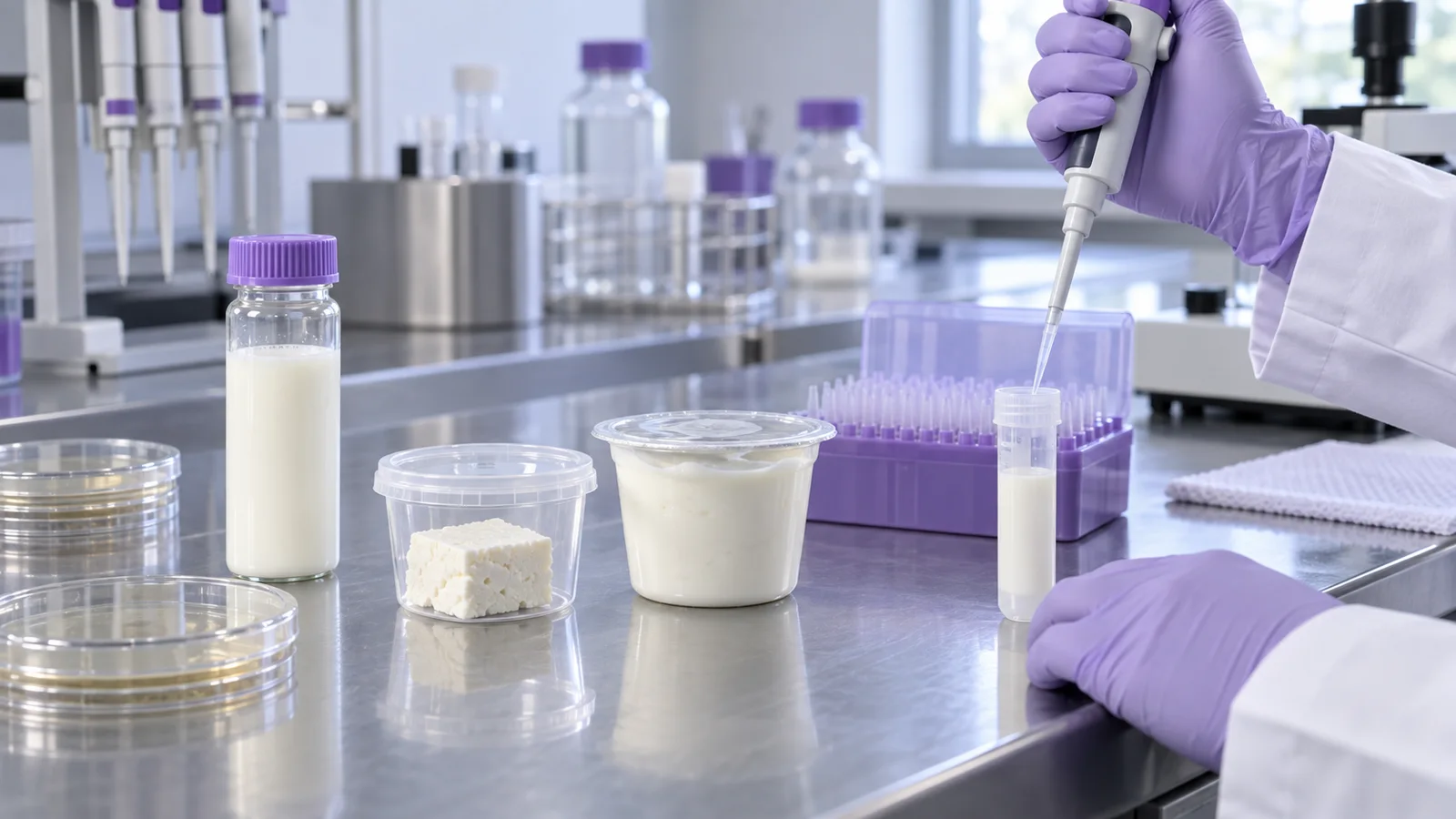
The dairy tests focused on a single bacterial isolate
A laboratory study published in the Brazilian Journal of Microbiology on 24 September 2026 found that dairy samples treated with the bacteriophage UHP46 had lower viable Staphylococcus aureus counts than controls. The experiments covered milk, cheese and yogurt, but all used the same bacterial strain, S46. The authors describe the work as an assessment of antibacterial efficacy rather than safety.
Bacteriophages are viruses that infect bacteria. The tested isolate was a previously characterised multidrug-resistant strain associated with bovine mastitis in Pakistan. The paper also cites an earlier screening in which UHP46 acted against four of 29 S. aureus isolates. The authors therefore identify its narrow host range as a limitation and call for testing against a broader strain panel.
Lower counts were measured against the corresponding controls
The reported reductions compare treated samples with untreated controls at the same sampling point. They describe the gap between the groups, rather than the change from the starting bacterial population. This distinction matters because bacterial growth in a control can increase that gap even when viable bacteria remain in the treated food.
The milk tests showed lower bacterial counts after phage treatment, with results varying across the storage conditions examined. In cheese, treated samples also remained below controls during the study, although bacterial counts rose again during extended storage. The authors discuss the possibility that a structured food matrix leaves some bacteria less accessible to the phage.
Yogurt results separate relative reduction from the final bacterial count
In yogurt, treated samples had lower viable counts than controls throughout the reported observation period. Average treatment–control differences were larger in the warmer groups, but the comparison among storage temperatures did not reach statistical significance. The authors present that pattern as suggestive rather than conclusive.
The lowest residual bacterial count in treated yogurt occurred under refrigeration, despite its smaller treatment–control difference. The authors also caution against directly ranking the three dairy products because yogurt started with a lower bacterial load than milk or cheese. They report that yogurt pH was not measured, which limits interpretation of the relationship between acidity and phage activity.
Several food-safety questions were outside the measurements
The study did not assess whether surviving bacteria had become resistant to the phage. The authors state that regrowth alone cannot distinguish acquired resistance from survival in locations or physiological states that limit contact with the phage. They identify that distinction as an unresolved question.
Effects on staphylococcal toxin production, dairy sensory properties and yogurt starter cultures were not established by these experiments. The paper identifies toxin inhibition and sensory effects as subjects for further evaluation. A possible limited impact on non-target microorganisms is discussed, but the authors explicitly state that it was not tested here.
The authors call for broader testing before commercial use
The paper refers to earlier genomic characterisation of UHP46 that did not detect known antibiotic-resistance genes, virulence factors or lysogeny-associated regions. Those earlier findings are separate from the present dairy challenge experiments. The conclusion states that further characterisation suitable for regulatory assessment would be needed before commercial use.
The authors also call for studies with additional S. aureus strains, including methicillin-resistant isolates, and under commercial processing conditions. The findings are presented as support for further evaluation of UHP46 in dairy applications, with the evidence confined to the tested strain and experimental foods.
The research received support from Pakistan's Higher Education Commission through its NRPU project. Open-access funding was provided through the CRUE-CSIC agreement with Springer Nature. The authors declared no commercial or financial conflicts of interest.
-
Biocontrol of Staphylococcus aureus in dairy products using lytic bacteriophage UHP46: efficacy in milk, cheese, and yogurt ↗
Brazilian Journal of Microbiology · CC-BY-4.0 ↗. Sara Najeeb, Imran Khan, Javed Muhammad, Muhammad Jahangir, Anza Abbas, Aman Ullah, Amjad Khan and Sumaira Miskeen (2026). Biocontrol of Staphylococcus aureus in dairy products using lytic bacteriophage UHP46: efficacy in milk, cheese, and yogurt. Brazilian Journal of Microbiology 57, article 278. DOI: 10.1007/s42770-026-02081-w. © The Author(s) 2026. CC BY 4.0. Editorial adaptation and translations: FoodRadar. Adapted by FoodRadar.