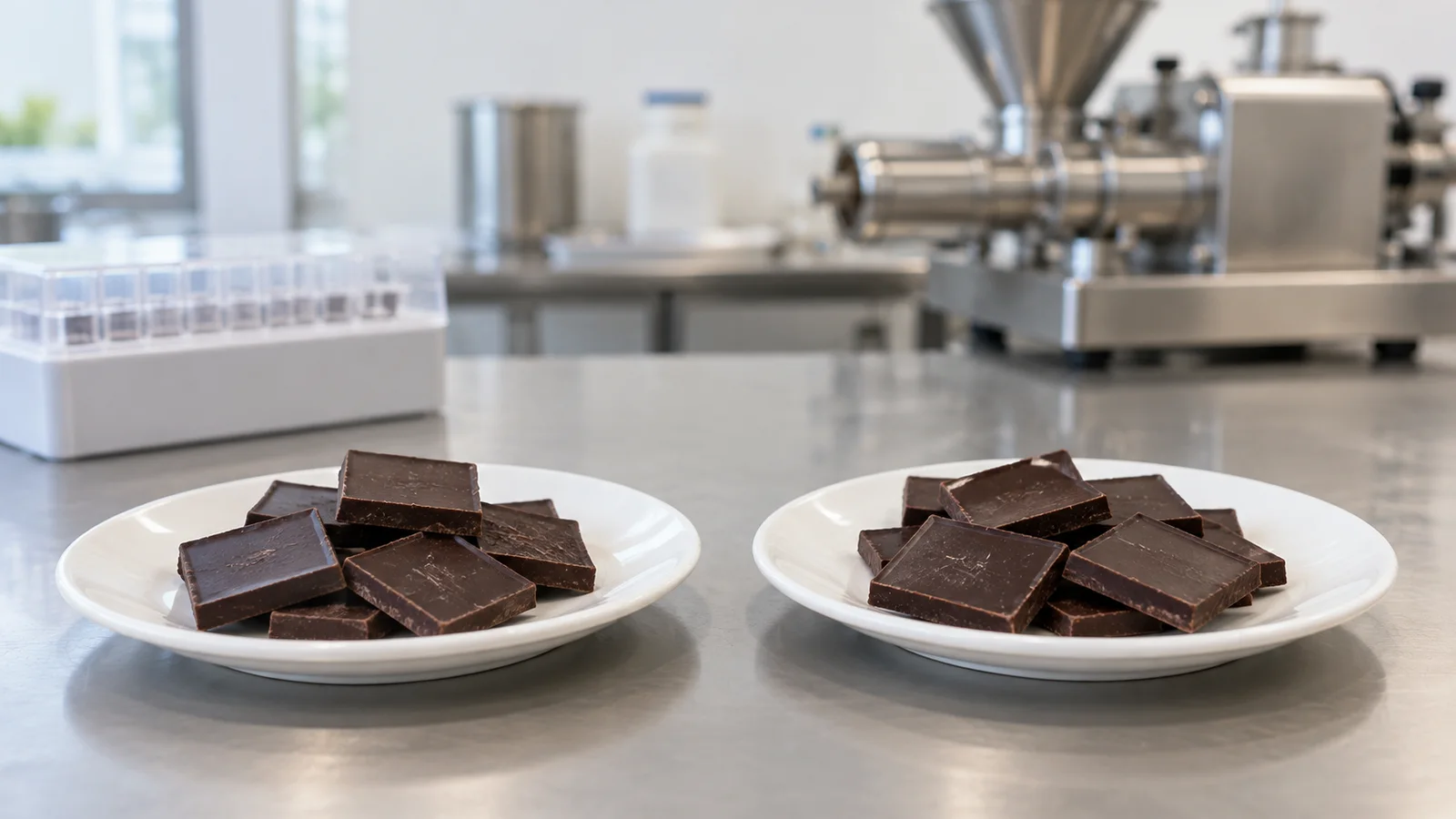
Each participant tested both chocolates
Chocolate made with a preliminary extrusion step produced a lower short-term insulin response than chocolate prepared without that step in a trial published in Food Science & Nutrition on 30 September 2026. Researchers from Morinaga & Co. Ltd. and Shiba Palace Clinic in Japan used a randomised, double-blind crossover design, with each participant consuming both chocolates on separate days.
Eighteen healthy Japanese men completed the study in February 2025. They were eligible at ages 20–60, and their average age was 48.7 years. The two test days were separated by more than a week. After a 12-hour fast, each participant ate 76 g of chocolate within five minutes. Blood was sampled before consumption and six times afterwards, up to 180 minutes.
The formulation was kept the same while part of the processing changed
For the extrusion version, part of the ingredients passed through a laboratory twin-screw extruder before the usual chocolate-making steps. The control omitted that preliminary extrusion step. Both formulations contained the same proportions of sugar, cocoa mass, milk powders, cocoa-butter equivalent and lecithin.
Nutrient analysis found 33.5 g of sucrose per 100 g in both chocolates. Measured fat was 33.6 g per 100 g in the extrusion version and 34.1 g in the control; protein was 11.1 and 11.3 g, respectively. The study therefore compared processing routes using the same formulation, rather than testing a reduction in the sugar added.
Insulin differences were clearer than the glucose findings
At 30 minutes, the mean increase in insulin from baseline was 20.6 μU/mL after the extrusion chocolate and 26.8 μU/mL after the control, a significant difference at the study’s p < 0.05 threshold. The cumulative incremental insulin response, measured as area under the curve, was also significantly lower through the 30-, 45-, 60-, 90- and 120-minute endpoints. The difference at 180 minutes was not significant.
At 45 minutes, glucose had risen by an average of 17.8 mg/dL after the extrusion chocolate and 25.1 mg/dL after the control. These are changes from fasting levels of approximately 96 mg/dL, not absolute glucose concentrations, and the between-chocolate difference did not reach p < 0.05. Triglyceride changes were significantly lower at 30 and 45 minutes. Neither glucose nor triglyceride incremental areas under the curve showed significant differences at that threshold.
Fullness and early sugar dissolution also differed
Questionnaires recorded hunger, fullness and desire to eat before consumption and at 60, 120 and 180 minutes. Fullness was greater after the extrusion chocolate at 120 minutes. The other between-chocolate comparisons for appetite did not show significant differences.
In a separate laboratory test, the researchers measured sugar release into a solution simulating saliva and gastric fluid. Digestive enzymes were omitted because the test focused on sugar dissolution. The extrusion chocolate released significantly less sucrose equivalent, a combined measure of sucrose and glucose, at five and fifteen minutes; this difference was no longer significant at thirty minutes. Lactose values were also lower, but did not reach the significance threshold.
The authors propose a physical explanation and identify study limits
The authors suggest that extrusion may change the physical arrangement of ingredients and slow sugar dissolution. They discuss food structure and possible changes in viscosity as explanations for the observations. The relationship between the blood-marker changes and the fullness result remains unexplained.
The paper identifies the all-male, mostly middle-aged sample as a limitation when considering age and sex differences. The researchers did not measure GLP-1. They also state that the long-term effects on satiety are not known.
Morinaga provided the research expenses and test samples. Seven authors disclosed employment by the company. The eighth author, a doctor at Shiba Palace Clinic, provided contractual services to conduct the clinical trial. The paper reports ethics approval and written informed consent; its data are available on request from the corresponding author.
-
Chocolate Processed by Extrusion Cooking Affects Glucose and Lipid Metabolism in Humans: A Randomized, Double‐Blind, Crossover Trial ↗
Food Science & Nutrition · CC-BY-4.0 ↗. Yasuyoshi Kinta, Hiroko Maruki-Uchida, Masahiro Umehara, Ryoichi Ito, Ryotaro Shiga, Yuki Yasumoto, Sadao Mori and Takashi Koikeda (2026). Chocolate Processed by Extrusion Cooking Affects Glucose and Lipid Metabolism in Humans: A Randomized, Double-Blind, Crossover Trial. Food Science & Nutrition 14(10), e72409. DOI: 10.1002/fsn3.72409. © 2026 The Authors. Published by Wiley Periodicals LLC. CC BY 4.0. Editorial adaptation and translation: FoodRadar. Adapted by FoodRadar.