The coating combines a particle-stabilised emulsion with chitosan
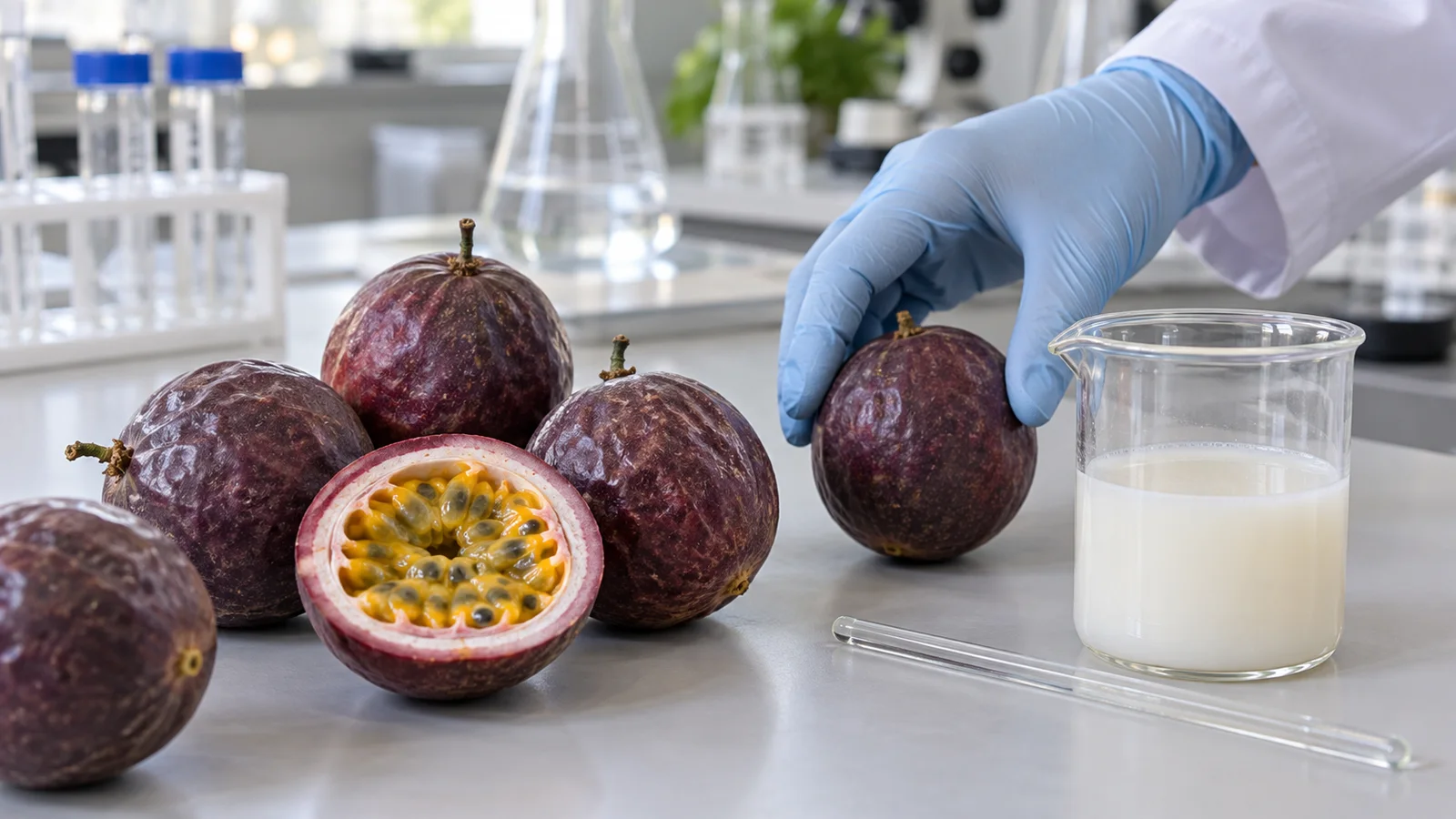
A composite coating reduced passion-fruit weight loss during seven days of storage in a study published in Ultrasonics Sonochemistry on 23 September 2026. Researchers at Changzhou University in China combined microfluidic particle preparation with ultrasonic emulsification to develop a coating containing ovalbumin, carvacrol, luteolin and chitosan.
Ovalbumin, a protein from egg white, was combined with carvacrol to form particles that stabilised an oil–water mixture, known as a Pickering emulsion. Luteolin was incorporated into the corn-oil phase. The emulsion was then blended with chitosan, which provided the film-forming matrix.
The fruit test compared three groups under the same storage conditions
The researchers randomly divided cleaned passion fruits into three groups of twenty: uncoated controls, fruit treated with chitosan alone, and fruit treated with the composite coating. The composite formulation contained a 50% emulsion fraction by volume. Coated fruit was dipped in the treatment liquid and air-dried before storage at 22 ± 2 °C.
The methods specify quality measurements on days 0, 3, 5 and 7. The team assessed weight loss, firmness, total soluble solids, titratable acidity, vitamin C and total phenols. Photographs and microscopy were also used to examine changes in fruit appearance and peel structure.
Weight loss was lower and firmness was better retained
By day seven, weight loss reached 10.2% in the composite-coated fruit and 17.4% in uncoated controls. The composite group also showed less shrinkage. The authors attribute the lower weight loss to a surface barrier that limits water loss during storage.
All groups lost firmness. At day seven, the reported values were 27.27 N/cm² for the composite coating, 20.07 N/cm² for chitosan alone and 17.33 N/cm² for uncoated fruit. The photographs showed more pronounced wrinkling in the control and chitosan groups than in the composite-coated fruit.
Soluble solids and acidity changed at different rates
Total soluble solids increased during storage, reaching 19.63 °Brix in the composite group and 25.43 °Brix in controls on day seven. The authors link this increase to ripening and water loss, which concentrates soluble substances. They report a slower increase in the coated fruit.
Titratable acidity declined from an initial 3.06% to 2.41% with the composite coating and 1.75% in controls. The paper also reports greater retention of total phenols in the composite group. The authors interpret these observations as slower quality deterioration during the storage period.
The materials tests examine how processing affects the coating
The team compared ultrasound conditions during emulsion preparation. Intermediate treatment produced finer, more uniform droplets than the stronger or longer treatments tested. The authors discuss changes in particle interactions and droplet aggregation as explanations for this behaviour.
Films with different emulsion fractions were compared for light transmission, surface wettability, water-vapour permeability and swelling. The formulation containing 50% emulsion was selected for the fruit experiment on the basis of these materials tests. The paper also reports separate laboratory antioxidant and antimicrobial assays.
The research was funded by the National Natural Science Foundation of China and the China Postdoctoral Science Foundation. The authors declared no known competing financial interests or personal relationships that could have influenced the work.
-
Microfluidics-engineered ovalbumin-carvacrol nanoparticles for ultrasonically fabricated pickering emulsion coatings: a sonochemical strategy for fruit preservation☆ ↗
Ultrasonics Sonochemistry · CC-BY-4.0 ↗. Song-Wei Lv, Zhu-Huan Tang, Zhi-Fan Ye, Yi-Jing Lu, Gao-Xiang Jin, He-Ling Yu, Da-Na Liu and Jianhao Wang (2026). Microfluidics-engineered ovalbumin-carvacrol nanoparticles for ultrasonically fabricated pickering emulsion coatings: a sonochemical strategy for fruit preservation. Ultrasonics Sonochemistry 133, 108073. DOI: 10.1016/j.ultsonch.2026.108073. © 2026 The Authors. Published by Elsevier. CC BY 4.0. Editorial adaptation and translation: FoodRadar. Adapted by FoodRadar.