Four methods tested on an industrial residue
A study published in Foods on 17 September 2026 compared four ways of extracting protein from brown-mustard (Brassica juncea) processing residue. The recovered concentrates contained 70.67–82.31% protein, but their dry weight amounted to only 0.80–1.14% of the dry starting material. The authors identify low extraction yield as a major obstacle to commercialisation.
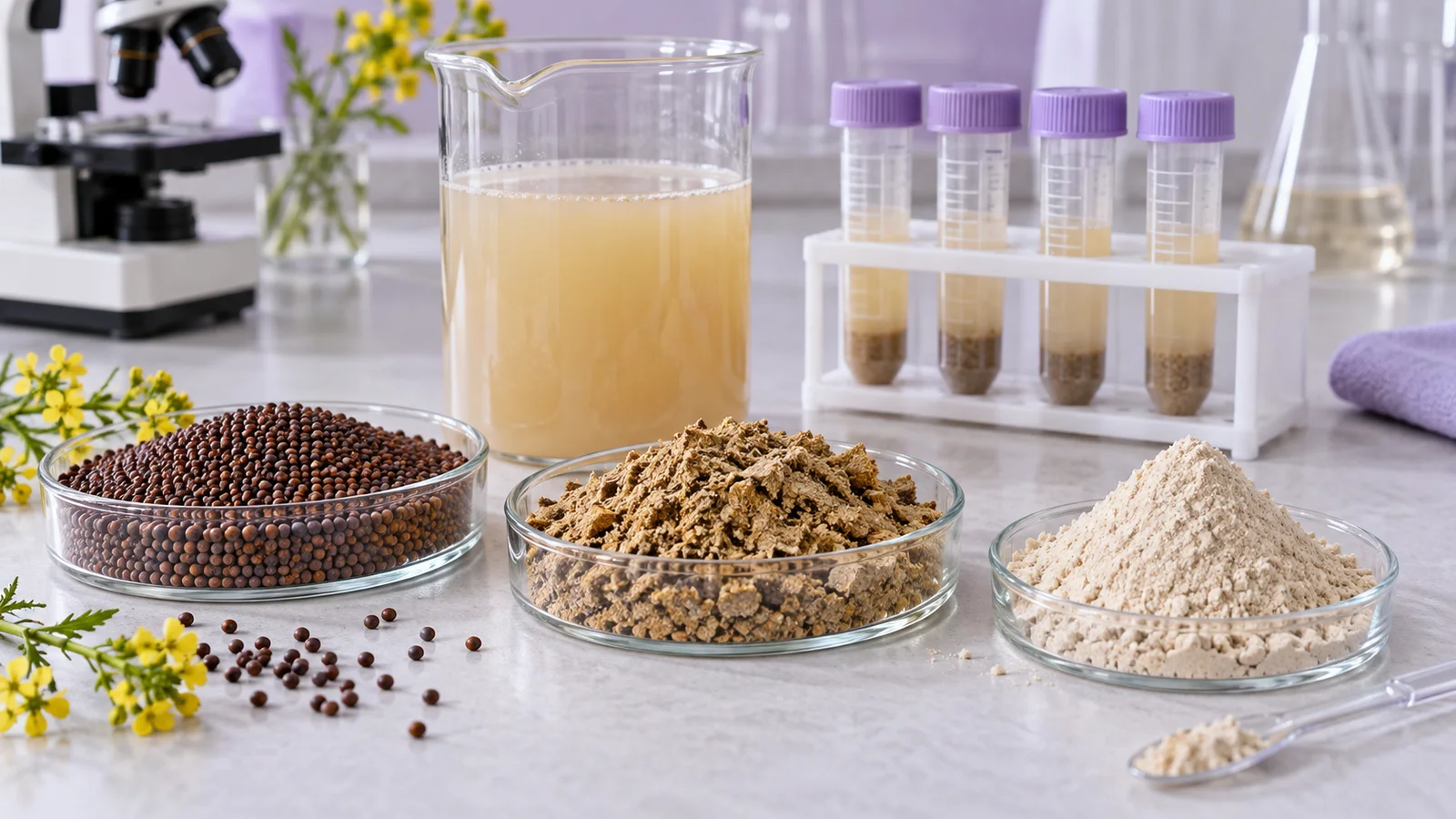
The residue came from a processor in Lamphun, Thailand, after mechanical oil pressing and essential oil distillation. Laboratory preparation included drying, hexane treatment to reduce fat content and milling. The researchers compared conventional alkaline extraction (CON), alkaline extraction following Viscozyme L enzyme pretreatment (ENZ), ultrasound-assisted alkaline extraction (US), and the combination of enzyme pretreatment and ultrasound (ENZ+US).
Protein concentration differed; weight yields showed no significant difference
Conventional extraction produced a concentrate containing 82.31% protein, compared with 77.88% for US, 74.96% for ENZ and 70.67% for ENZ+US. These protein concentrations differed significantly. By contrast, the differences in dry concentrate weight yield were not statistically significant. The authors report that the concentrates recovered only 1.65–2.50% of the protein originally present in the starting material.
The study measured protein content, colour, protein structure, solubility, oil absorption, foaming, emulsification, antioxidant activity and in-vitro digestibility. Experiments were conducted at least in triplicate, with results reported as means and standard deviations; statistical significance was set at p < 0.05. The authors suggest that heat exposure during earlier industrial processing may partly explain the low extraction yield.
Emulsification and antioxidant assays favoured different methods
Conventional extraction gave the highest emulsifying activity index: 42.15 ± 0.69 m²/g, significantly above the 23.26–27.36 m²/g reported for the three assisted methods. This index measures the ability to form an emulsion in the laboratory test. Oil absorption capacity ranged from 3.57 to 3.80 mL/g across the concentrates.
The two enzyme-assisted methods gave significantly higher results than the methods without enzyme pretreatment in four antioxidant assays: Folin–Ciocalteu reducing capacity, DPPH and ABTS radical scavenging, and ferric reducing antioxidant power. The iron-chelating assay showed a different pattern, with conventional extraction giving the highest result at 1.99 ± 0.03 mg EDTA equivalents per gram. The authors suggest that non-protein compounds extracted alongside the proteins contributed to the enzyme-assisted concentrates’ antioxidant activity.
Lower digestibility in the enzyme-assisted concentrates
Digestibility was measured in a laboratory model using pepsin followed by trypsin. Conventional extraction gave 67.63 ± 0.40% digestibility and US gave 66.19 ± 0.43%; the enzyme-assisted concentrates were lower, at 43.95–50.02%. The authors propose that antinutrients released during enzyme pretreatment and precipitated with the proteins may contribute to this difference.
The authors conclude that extraction method changes the combination of properties obtained: enzyme assistance improved several antioxidant assay results, while conventional extraction produced the highest emulsifying activity and protein concentration. They state that improving the low extraction yield will be essential to industrial and economic feasibility.
-
Effects of Extraction Methods on Physicochemical, Functional and Nutritional Properties of Protein Extracted from Mustard (Brassica juncea) Seed Meal Residue ↗
Foods · CC-BY-4.0 ↗. Piyathida Chanaim, Siraphat Taesuwan, Suphat Phongthai, Dayong Zhou, Qi Zhao and Kanyasiri Rakariyatham (2026). Effects of Extraction Methods on Physicochemical, Functional and Nutritional Properties of Protein Extracted from Mustard (Brassica juncea) Seed Meal Residue. Foods 15(18),3294,published 17 September 2026. DOI:10.3390/foods15183294. Copyright 2026 by the authors. CC BY 4.0. Editorial adaptation and translation: FoodRadar. Adapted by FoodRadar.