One milk sample from each of 242 farms
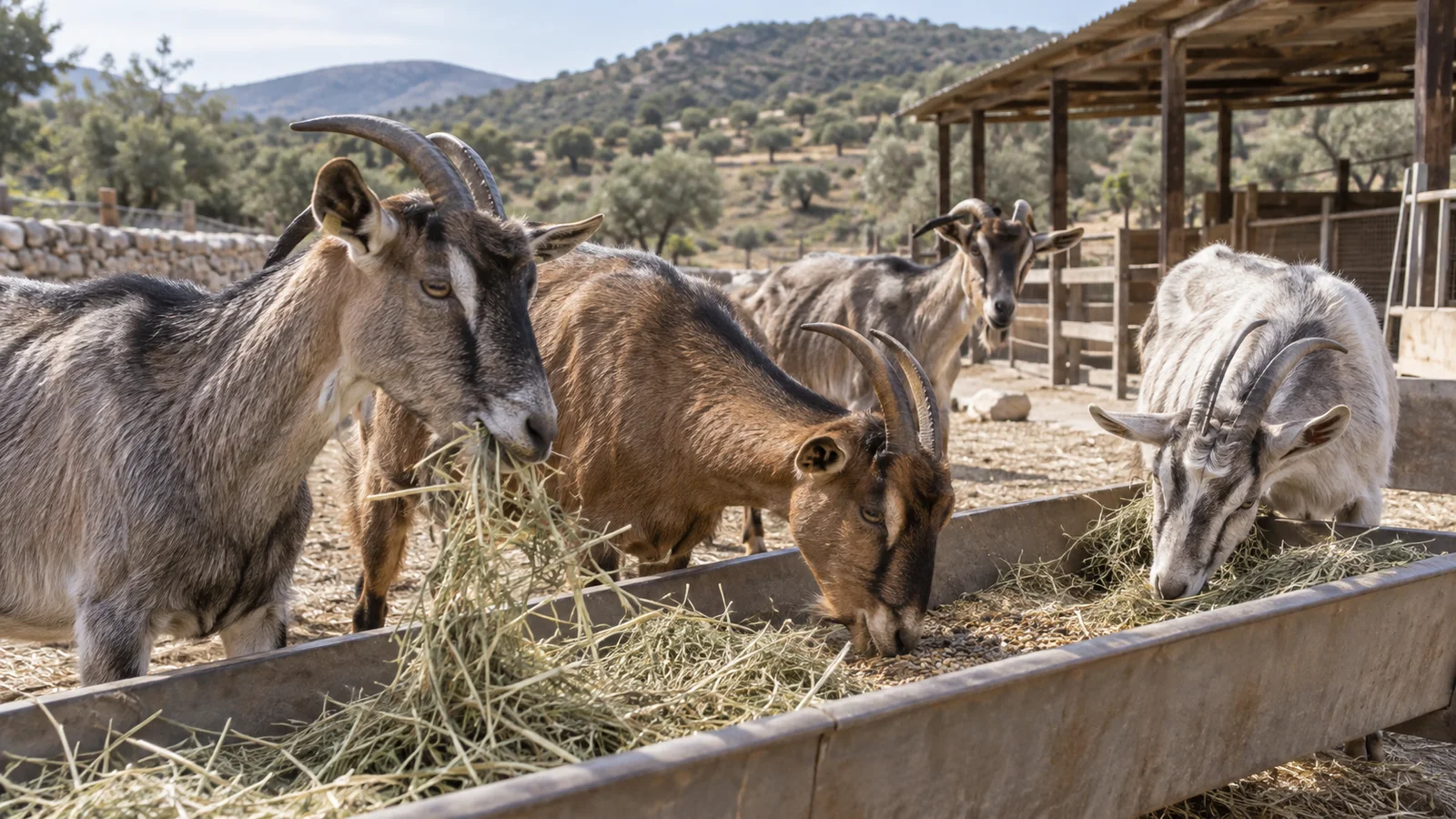
A study published in Animals examined associations between feeding management and goat milk composition on 242 semi-intensive farms in Central Macedonia, northern Greece. The farms reared indigenous Greek goats in systems combining grazing with supplementary feeding. Researchers collected a single milk sample from one lactating goat on each farm and obtained questionnaire responses about routine feeding during early, mid- and late lactation.
The farms were recruited through convenience sampling because no comprehensive regional sampling frame was available and participation depended on farmers' willingness to provide samples and information. Milk composition was measured at the sampled goat's current lactation stage. Feeding responses described routine farm management across the three stages rather than the ration consumed by that goat on the sampling day.
A combined measure of milk composition
The researchers used structural equation modeling to examine interconnected feeding practices and biological covariates. Milk quality was defined as a latent construct comprising protein, fat, lactose and solids-not-fat. The final model retained seven feeding-management predictors and explained 46.6% of the variance in this combined measure.
Among the retained feeding practices, supplying 300–500 g/day of concentrate during mid- and late lactation had the strongest positive association with the latent milk-quality construct. Other positive associations involved grass–legume hay during mid-lactation, protein concentrates during early and late lactation, a dairy mix containing vitamins and minerals, reported pasture intake of 3–4 kg/day during early or mid-lactation, and a goat balancer during late lactation.
Component associations differed by practice
For the 300–500 g/day concentrate practice, the model's unstandardized total effects corresponded to 5.97% higher protein, 5.13% higher fat, 2.84% higher solids-not-fat and 1.51% higher lactose concentrations. These are proportional associations for the reported presence versus absence of the practice, combining direct and indirect model paths. The estimated fat association was larger for pasture intake of 3–4 kg/day during mid-lactation, at approximately 10.2%.
Higher annual milk yield was associated with lower protein, fat and solids-not-fat concentrations and higher lactose concentration. The authors discuss this pattern as a dilution effect: lower concentrations do not necessarily imply lower total production of milk constituents. Across the sampled goats, mean milk composition was 4.81% fat, 3.82% protein, 4.44% lactose and 9.19% solids-not-fat.
Farm-level associations and study limitations
The authors interpret the findings as associations between farm-level management and milk composition. The cross-sectional design does not establish temporal precedence or causal effects, and sampling one goat per farm does not estimate variation among animals within a herd. Convenience sampling and the restriction to Central Macedonia limit generalizability. Body weight, body condition score and parity were not recorded, leaving possible residual confounding.
Several feeding variables were combined across lactation stages because farmers' responses were strongly correlated; the authors note that this may obscure subtle stage-specific changes. They call for longitudinal or controlled feeding studies, repeated measurements from multiple animals per farm, precise feed-intake and nutrient measurements, and validation in independent goat populations and other production systems.
-
Associations Between Feeding Management Practices Across Lactation and Goat Milk Composition in Semi-Intensive Systems: A Structural Equation Modeling Approach ↗
Animals : an Open Access Journal from MDPI · CC-BY-4.0 ↗. Vasileios Alexandridis, Eleni Malissiova, Natalia Vasileiou and Dimitrios Kantas (2026). Associations Between Feeding Management Practices Across Lactation and Goat Milk Composition in Semi-Intensive Systems: A Structural Equation Modeling Approach. Animals 16(15), 2428. DOI: 10.3390/ani16152428. © 2026 by the authors. CC BY 4.0. Editorial adaptation and translation: FoodRadar. Adapted by FoodRadar.