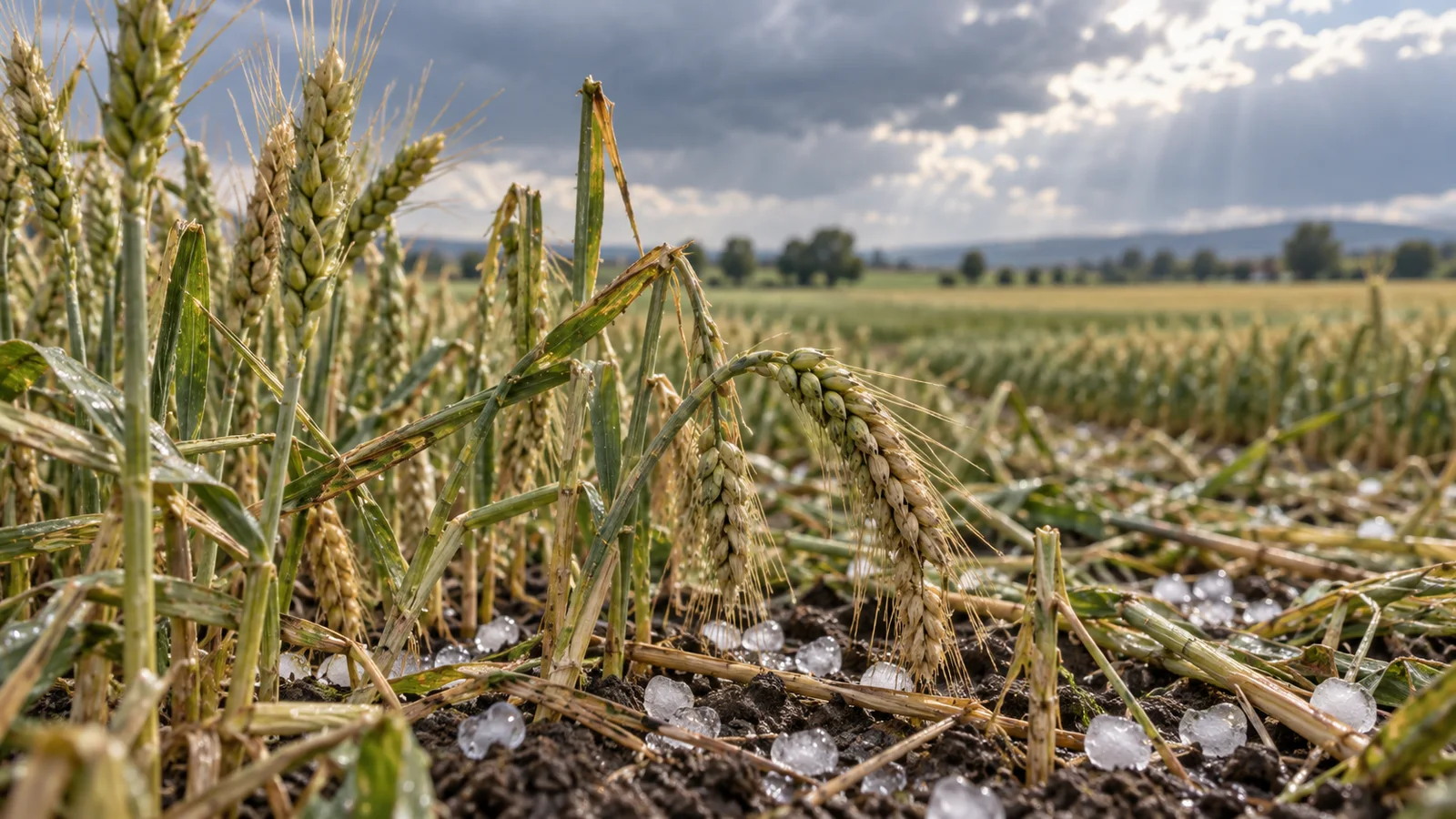
A natural hail event in a wheat breeding trial
A study published in Frontiers in Plant Science on 11 August 2026 examined winter-wheat breeding trials affected by hail near Bozeman, Montana, on 6 August 2024. Researchers assessed visible mechanical damage the following day, considering defoliation, stem and spike breakage, and grain shattering. Grain yield was recorded at harvest.
Damage varied across the field. The researchers modelled row and column patterns within each trial to account for spatial heterogeneity and experimental design. The study reports variation in both adjusted grain yield and hail-damage scores.
Yield and damage were associated, with differences between trials
The authors report an overall negative correlation between grain yield and hail-damage scores. They also report a weak, non-significant positive correlation in the advanced yield trial, which they say should not be interpreted as evidence that yield increases with hail damage.
Broad-sense heritability estimates differed between trials and between entry and plot levels. The authors interpret the results as evidence of genetic contributions to variation in injury and post-hail grain yield under the conditions studied.
Preliminary associated regions require further validation
The final quality-filtered genome-wide association panel contained 189 genotypes and 16,039 markers. The analysis accounted for population structure. The authors compared the positions of associated markers with previously reported regions related to stem strength and spike architecture.
The authors state that systematic data directly supporting the proposed architectural mechanism were unavailable, and that functional validation is needed to determine candidate genes’ direct roles. They identify reliance on one natural hail event at one growth stage as a key limitation. The reported loci and candidate genes are preliminary signals requiring validation across additional environments, populations and controlled mechanical-stress tests.
Cover illustration
AI-generated conceptual image of hail-damaged wheat. It is not a photograph of the 2024 study site or evidence of a particular variety’s resistance.
Source and reuse
Source: Arpit Gaur, Andrew Lehnerz, Duncan Pantos, Ricardo Leiton, Ronald Ramsfield and Suchismita Mondal, Frontiers in Plant Science, 11 August 2026. DOI: 10.3389/fpls.2026.1904031. © 2026 Gaur, Lehnerz, Pantos, Leiton, Ramsfield and Mondal. CC BY 4.0. FoodRadar prepared and edited this summary. No source figure or photograph is reused.
Research article: https://www.frontiersin.org/journals/plant-science/articles/10.3389/fpls.2026.1904031/full — Licence: https://creativecommons.org/licenses/by/4.0/
-
Can we breed hail-resilient wheat? Insights from a hail affected breeding trial ↗
Frontiers in Plant Science · CC-BY-4.0 ↗. Arpit Gaur, Andrew Lehnerz, Duncan Pantos, Ricardo Leiton, Ronald Ramsfield and Suchismita Mondal (2026). Can we breed hail-resilient wheat? Insights from a hail affected breeding trial. Frontiers in Plant Science. DOI: 10.3389/fpls.2026.1904031. © 2026 Gaur, Lehnerz, Pantos, Leiton, Ramsfield and Mondal. CC BY 4.0. Editorial adaptation and translation: FoodRadar. Adapted by FoodRadar.