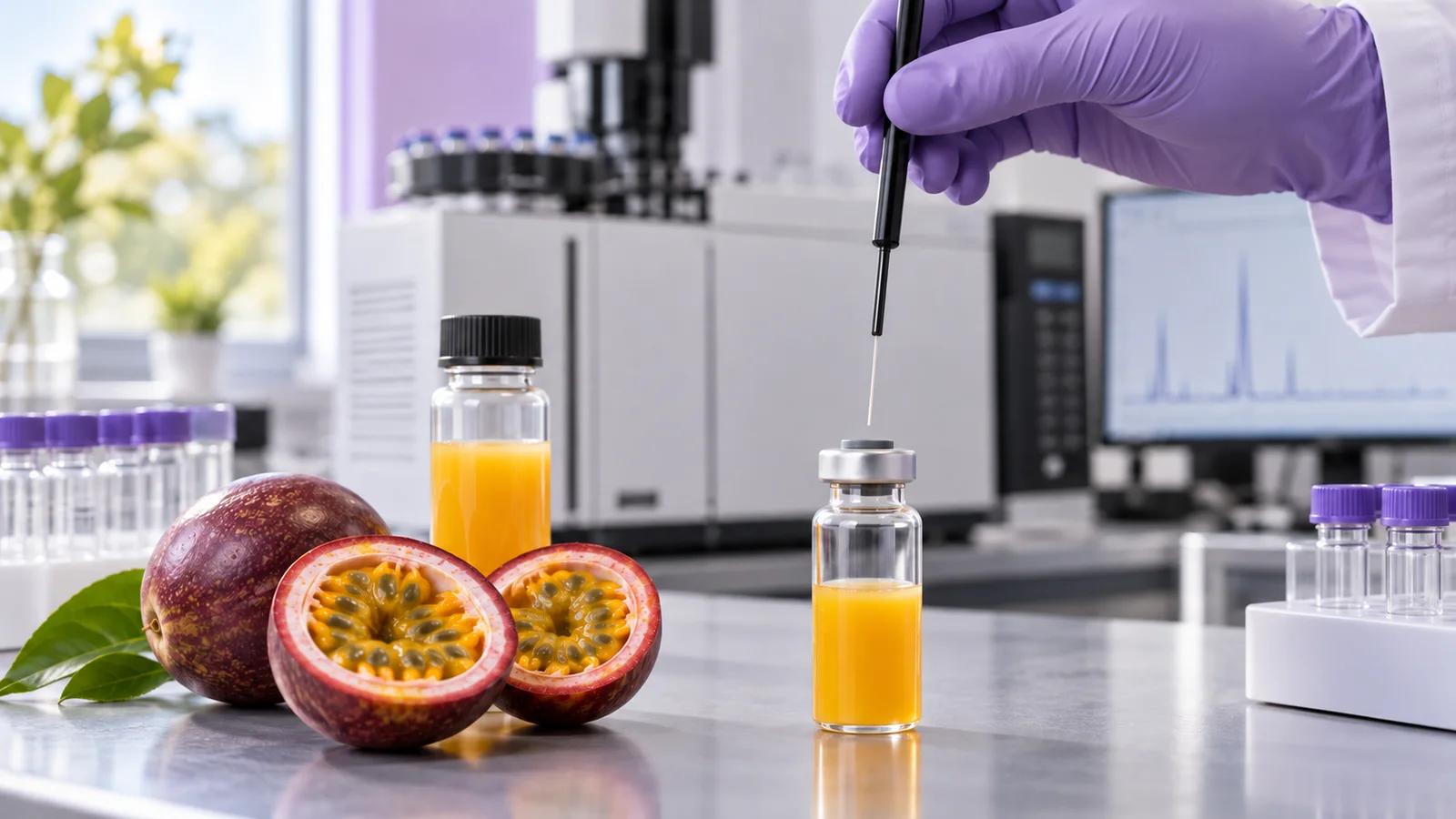
Different coatings tested on a common juice pool
A metal-organic framework coating helped researchers detect compounds in passion-fruit juice that commercial extraction fibres did not detect in the same comparison. The study, published in the Journal of Separation Science on 27 September 2026, examined CIM-80(Al) grown on braided silver wires as a coating for solid-phase microextraction coupled with gas chromatography–mass spectrometry (GC-MS). The authors propose using it alongside commercial coatings to broaden chemical profiling.
The researchers collected about 25 ripe passion fruits from plants in Güímar, Tenerife, Spain. They pooled the juices to keep sample composition the same across comparisons. The study examined both headspace sampling, in which the fibre samples the space above the juice, and direct immersion of the fibre into the juice.
Headspace sampling showed different extraction preferences
In the headspace comparison, the study reports 52 tentatively identified compounds across the three coatings: Car/PDMS, DVB/Car/PDMS and CIM-80(Al). The respective coating totals were 29, 26 and 25. Ten compounds were detected only with the MOF-coated fibre in this comparison.
The authors found that the commercial coatings favoured more volatile, lower-molecular-weight compounds, while the MOF coating showed greater affinity for heavier, less volatile and less polar compounds. Additional comparisons of selected compounds supported this difference in extraction preference.
Direct immersion added a second chemical profile
The direct-immersion comparison used Car/PDMS, PDMS and CIM-80(Al) fibres and yielded 26 tentative compound identifications in total. The MOF-coated fibre accounted for ten, including four detected only with that coating in this mode: three acids and 5-methylfurfural. These were separate headspace and direct-immersion comparisons.
The analytical workflow compared mass spectra with the NIST library and experimental retention indices with literature values. The authors also used analytical standards to confirm common volatile compounds. They describe the broader compound profiles as tentative identifications and carried out the profile comparisons in triplicate.
Reuse tests and complementary profiling
To assess fibre stability during direct immersion, the researchers measured extraction of reference compounds before and after exposure to juice. The results describe similar average extraction efficiency before and after immersion. The conclusions report a lifetime of around 20 direct-immersion analyses, comparable with the commercial fibres tested.
The authors conclude that the coatings’ different affinities make them complementary tools for analysing complex food samples. Combining MOF and commercial fibres provided a more comprehensive view of the passion-fruit juice profile than relying on one extraction coating.
-
A Dual Approach Combining Metal‐Organic Frameworks and Commercial Solid‐Phase Microextraction Coatings for Monitoring Volatiles in Passion Fruit ↗
Journal of Separation Science · CC-BY-4.0 ↗. Montse Saura-Cayuela, Martina Rosso, Cecilia Cagliero, Jorge Pasán, Juan H. Ayala, Verónica Pino and María J. Trujillo-Rodríguez (2026). A Dual Approach Combining Metal-Organic Frameworks and Commercial Solid-Phase Microextraction Coatings for Monitoring Volatiles in Passion Fruit. Journal of Separation Science 49, e70543. Published 27 September 2026. DOI:10.1002/jssc.70543. Copyright The Author(s) 2026; published by Wiley-VCH GmbH. CC BY 4.0. Editorial adaptation and translation: FoodRadar. Adapted by FoodRadar.