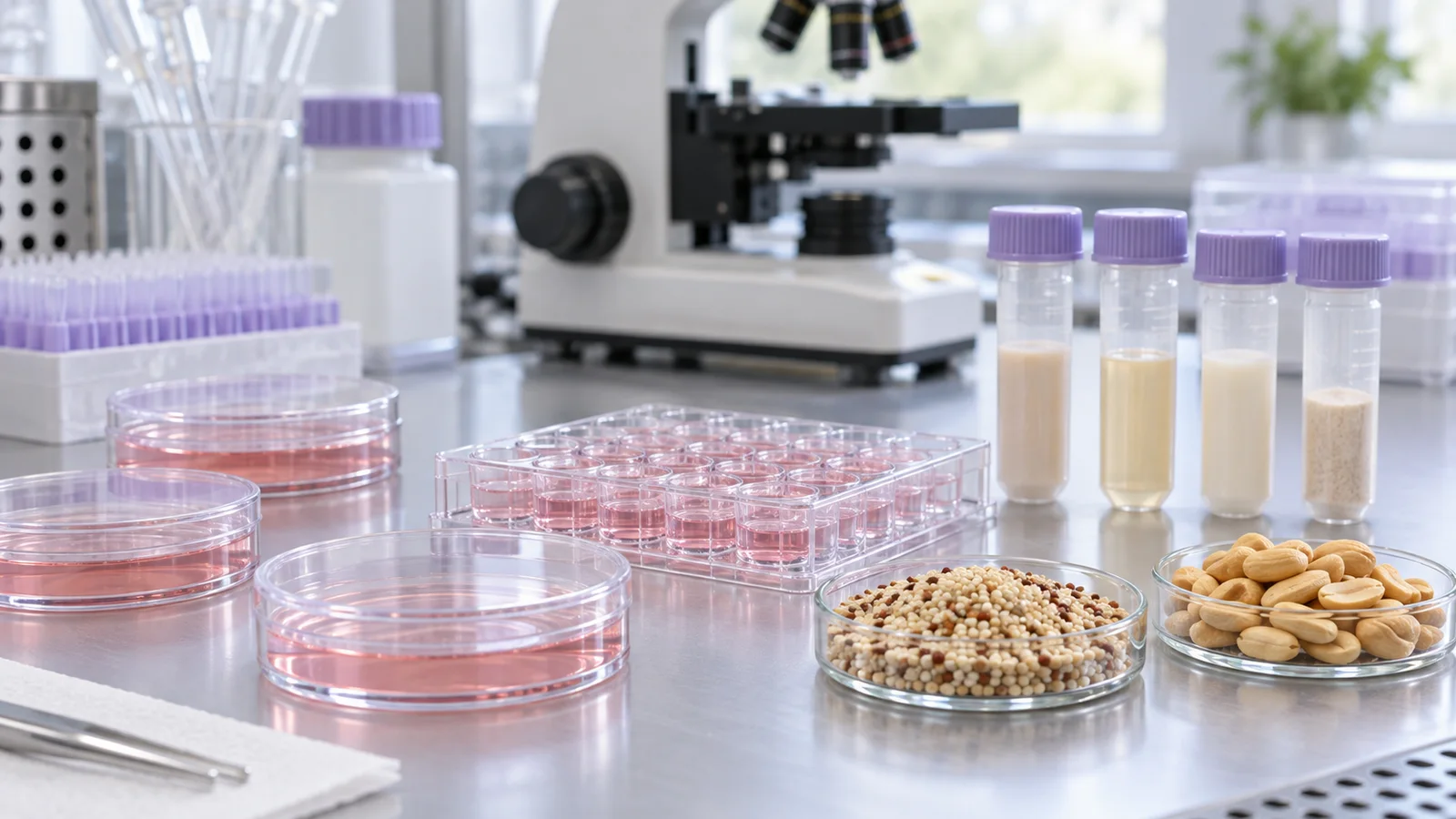
The study tests coatings for cells used in cultured-meat research
Water-soluble extracts from quinoa and peanut seeds supported muscle-cell attachment and growth on laboratory surfaces in a study published in the Journal of Food Science on 27 September 2026. Researchers at Fraunhofer IME and RWTH Aachen University investigated the extracts as alternatives to animal-derived proteins used to coat cell-culture surfaces.
The experiments used mouse C2C12 myoblasts and an immortalised bovine satellite-cell line. Coated dishes were compared with uncoated surfaces, albumin coatings and positive controls based on gelatin or vitronectin. The culture media contained animal serum. Microscopy and a metabolic assay were used to assess attachment and growth.
The bovine-cell response was lower than the vitronectin control
For mouse cells, both plant extracts supported attachment and proliferation in the range observed with gelatin under the tested conditions. After five days, the plant-coated surfaces gave higher metabolic-assay signals than the uncoated control. The assay measures activity associated with viable cells and was used by the authors as a readout of cell growth.
In bovine cells, quinoa-coated surfaces produced a higher metabolic-assay response than peanut-coated surfaces, but both remained below the vitronectin control. The authors note that protein adsorption, surface coverage and distribution were not fully controlled.
Coating concentration and differentiation require further investigation
At the highest quinoa coating concentration tested, the metabolic assay indicated fewer viable cells than on the uncoated control. The authors discuss residual saponins as one possible explanation, but they did not measure saponin content. They also identify changes in protein aggregation, surface coverage or accessibility of cell-interacting sites as possible contributors.
The researchers assessed muscle differentiation over eight days for mouse cells and twelve days for bovine cells. They observed elongated cells and myogenic markers on the coated surfaces, but differentiation was less pronounced than on standard tissue-culture surfaces. The authors report that differentiation was not fully advanced and call for further work to assess the coatings’ effects reliably.
The proposed adhesion mechanism is not yet established
The team searched for plant proteins containing the Arg–Gly–Asp sequence, known as the RGD motif, which can participate in cell attachment. Protein analysis identified candidates in both seed extracts. An inhibition experiment with the peanut coating suggested that RGD-related interactions may contribute to attachment.
The researchers then tested protein-containing mixtures made in a tobacco-cell-derived, cell-free production system. The selected protein or protein region was not purified out of the mixture. The resulting coatings supported cell attachment, but did not significantly outperform the production mixture without the added protein product. The authors therefore state that the selected proteins have not been shown to cause the extracts’ adhesion effects on their own.
Allergen activity and extract consistency remain open questions
The peanut extract contained major allergens, including Ara h 2 and Ara h 6. The authors state that protein identification by mass spectrometry does not establish retained allergenic activity in the coating or final food. They call for immunoreactivity testing of the extracts, coatings and final products. The absence of specifically identified allergens in the quinoa analysis also does not exclude allergenic proteins.
Variation between retail seed batches was not investigated. The authors propose further characterisation of the coatings and tests with purified candidate proteins and appropriate controls. Their conclusion presents defined plant-derived formulations, scalability and food compatibility as development goals alongside food-safety assessment.
The work was funded through Fraunhofer-Gesellschaft’s PACT programme and the EU Horizon Europe FEASTS project. Open-access funding was organised through Projekt DEAL. The authors declared no conflicts of interest.
-
Quinoa and Peanut Extracts as Alternatives to Animal‐Derived Extracellular Matrix Proteins in Cultured Meat Production ↗
Journal of Food Science · CC-BY-4.0 ↗. Dominik Mundt, Kuo-Hui Chiu, Stefan Schillberg and Che Julius Ngwa (2026). Quinoa and Peanut Extracts as Alternatives to Animal-Derived Extracellular Matrix Proteins in Cultured Meat Production. Journal of Food Science 91, e71509. DOI: 10.1111/1750-3841.71509. © 2026 The Authors. Published by Wiley Periodicals LLC on behalf of the Institute of Food Technologists. CC BY 4.0. Editorial adaptation and translation: FoodRadar. Adapted by FoodRadar.