Twelve cuts, tested separately
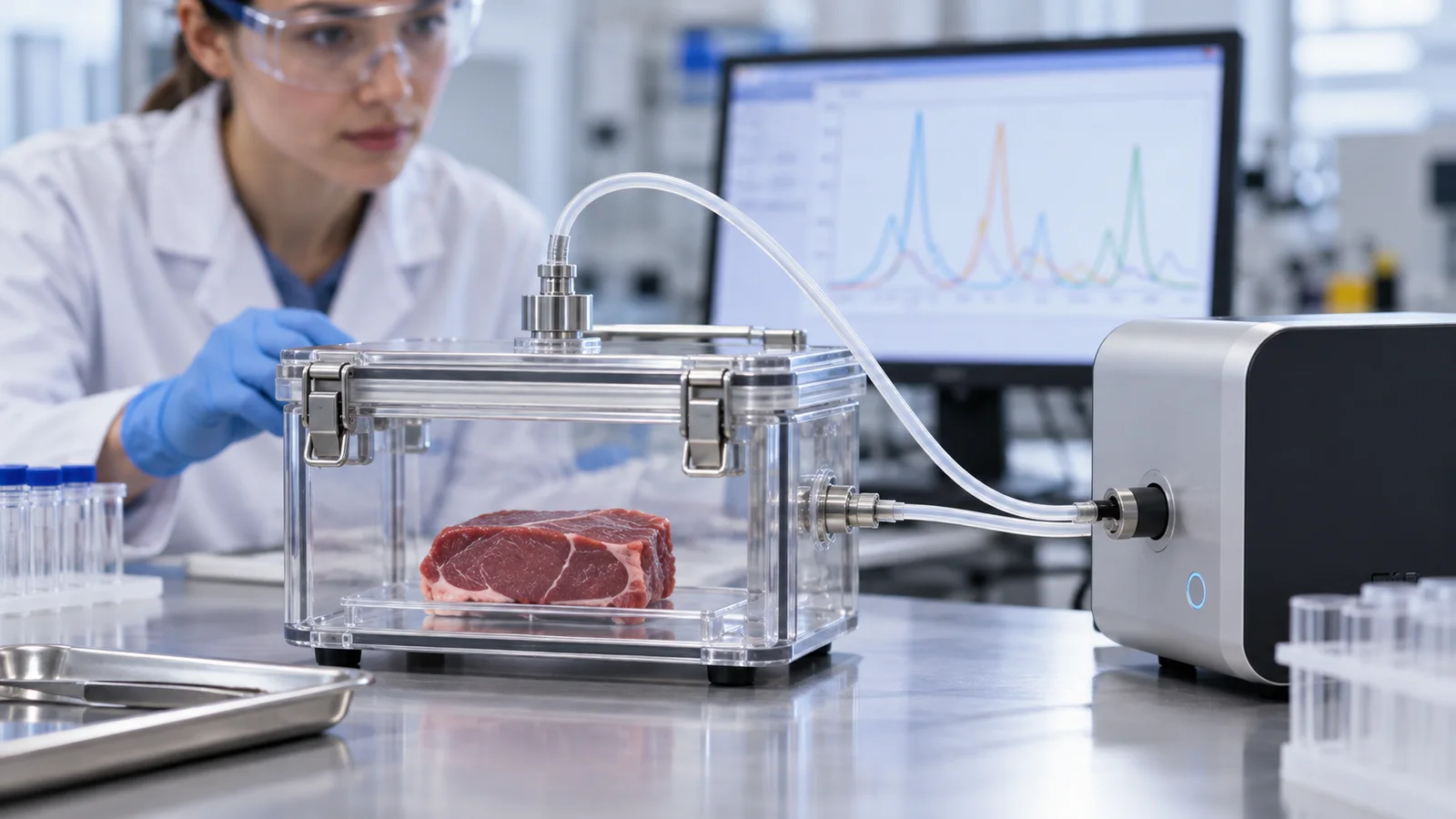
A study by Erkan Caner Ozkat, published in Foods on 10 August 2026, reanalysed public electronic-nose data for beef freshness. The primary dataset contains 12 cuts recorded with 11 metal-oxide gas-sensor channels. Each test held out one complete cut while models trained on the others; total viable count, or TVC, defined the freshness labels but was excluded from model inputs.
Across these tests, the gradient-boosted-tree pipeline achieved accuracy of 0.81 ± 0.10 and macro-F1 of 0.68 ± 0.15. The raw-sequence neural network reached macro-F1 of 0.50 ± 0.15. When the same network was evaluated using random splits instead, macro-F1 rose to 0.97. A separate comparison supplying TVC as an input produced near-perfect random-forest accuracy; the author does not establish that these procedures caused any specific earlier publication’s result.
Features and fewer sensor channels
When a neural network received the same window summaries as the tree, it reached macro-F1 of 0.64 ± 0.17, with no statistically significant difference from the tree in the paired comparison. A five-channel subset selected within training folds reached macro-F1 of 0.64, versus 0.68 for the full array; that difference was also not significant. The author states that a physical reduced array still needs construction and validation.
Separate coffee and aroma datasets tested the role of richer heater-profile signals. On the coffee task, a position-aware neural network exceeded the tree, and its advantage reversed when the profile was reduced to one step. On the seven-class aroma task, the tree remained stronger. The author describes these datasets as signal-structure comparisons rather than additional meat-quality validation.
Reference data and transfer limits
Ten of the 12 cuts share a partially identical TVC reference series. The author therefore distinguishes validation across 12 sensor acquisitions from validation across 12 independent microbial trajectories. On a separate beef acquisition, transfer macro-F1 was 0.40 for the tree and 0.46 for the neural network. The author reports that per-device standardisation improved the network, using unlabelled recordings from the target acquisition.
The author calls for broader validation across laboratories, storage conditions and longer periods, noting that the 37-hour acquisitions cannot characterise long-term sensor drift. The paper describes TVC as a freshness measure rather than a measure of pathogen or toxin presence. The study was supported by the Recep Tayyip Erdoğan University Development Foundation, grant 02026007008461; the author declared no conflicts of interest.
Source and licence
Source: Erkan Caner Ozkat. Leakage-Free Benchmarking of Electronic Noses for Beef Freshness: A Signal-Richness Criterion for Model Selection. Foods (2026), 15, 2798. DOI: 10.3390/foods15162798. © 2026 by the author. CC BY 4.0. FoodRadar prepared and edited this summary.
-
Leakage-Free Benchmarking of Electronic Noses for Beef Freshness: A Signal-Richness Criterion for Model Selection ↗
Foods · CC-BY-4.0 ↗. Erkan Caner Ozkat (2026). Leakage-Free Benchmarking of Electronic Noses for Beef Freshness: A Signal-Richness Criterion for Model Selection. Foods 15(16), 2798. DOI: 10.3390/foods15162798. © 2026 by the author. CC BY 4.0. Adapted, edited and translated by FoodRadar. Adapted by FoodRadar.