Four malt extracts were compared with chromatographic measurements
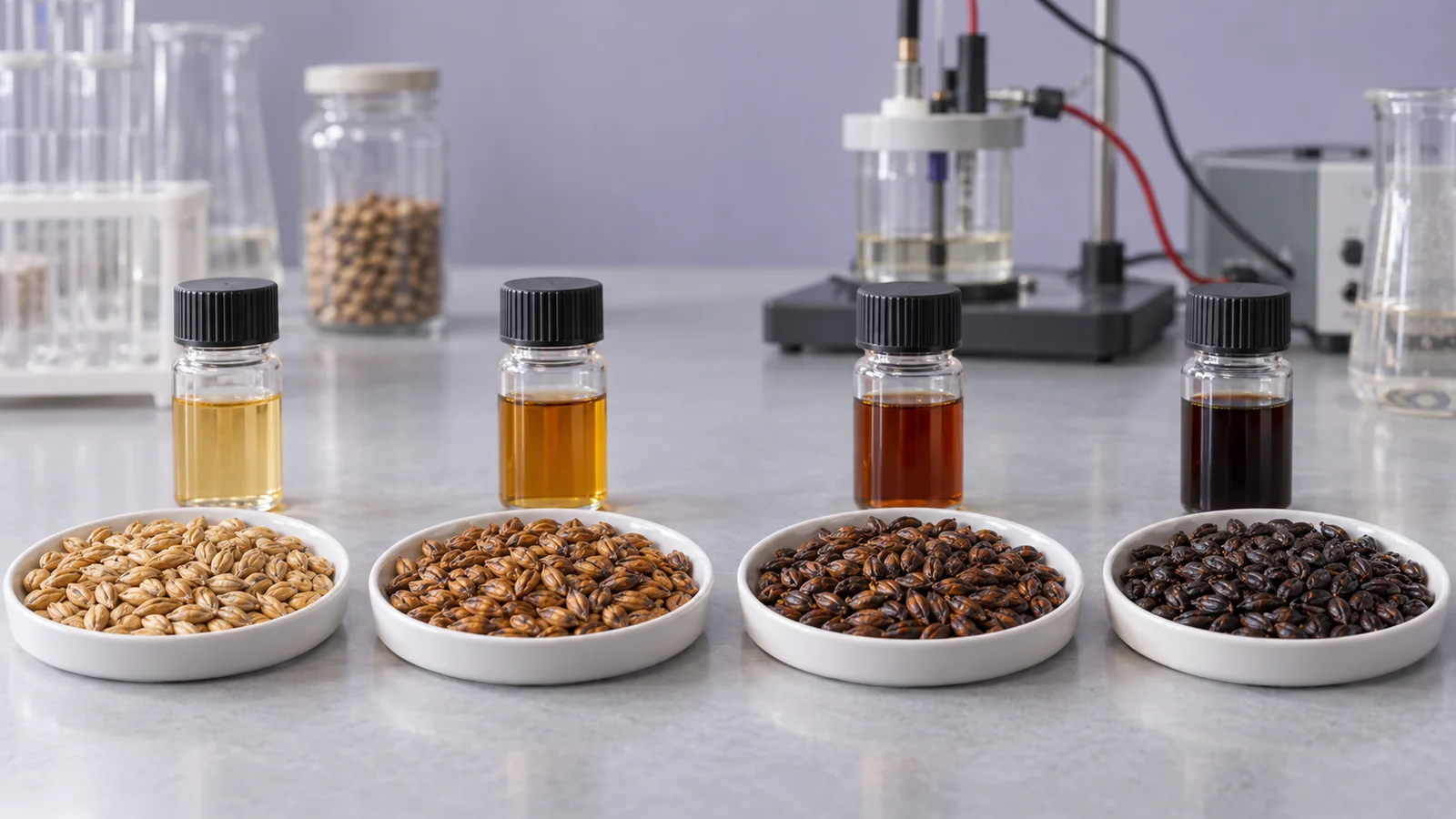
A laboratory biosensor built around the human smell receptor OR5K1 produced different electrical responses to liquid extracts of pilsner, Munich, crystal and caramel malts. Caramel malt gave the largest response and pilsner the smallest. In the study, published in Foods on 21 September 2026, the researchers compared these signals with chromatographic measurements of pyrazines, compounds associated with roasted and nutty aromas.
The sensor uses OR5K1 as its recognition element. The receptor was produced in yeast and incorporated into membrane-derived nanovesicles on an electrode. Its supporting matrix combined gold nanoparticles, Prussian blue, ZIF-8, single-walled carbon nanotubes and Ti₃C₂ MXene. The authors describe these materials as helping immobilise the receptor-containing vesicles and support electron transfer.
Calibration used one representative pyrazine standard
Before testing the malt extracts, the researchers calibrated the sensor with 2,3,5-trimethylpyrazine, abbreviated TMP, which gave the largest response among the pyrazines tested. They used TMP solutions spanning 10⁻¹⁴ to 10⁻⁹ mol/L. As TMP concentration increased, the measured peak current fell; the difference from the initial current served as the analytical signal.
The sensor also responded to pyrazine, tetramethylpyrazine and three dimethylpyrazine compounds. Separate electrochemical measurements followed changes in the electrode as its layers were added. The authors attribute the sensor response to the combined receptor-containing film and nanomaterial matrix.
The malt comparison covered four prepared extracts
The four malt samples differed in roasting degree. Powdered malt underwent ethanol extraction followed by concentration. The researchers then used gas chromatography–time-of-flight mass spectrometry, or GC-TOF/MS, to identify volatile compounds and estimate their concentrations by semi-quantitative analysis.
The authors reported the lowest sensor response for pilsner malt, at 4.6 ± 0.2 µA, and the highest for caramel malt, at 108 ± 6 µA. Their corresponding total pyrazine values from GC-TOF/MS were 0.092 ± 0.004 and 0.39 ± 0.02 mg/kg. Across the four malt extracts, the paper reports a correlation coefficient of 0.96 between sensor response and pyrazine content.
Selectivity and storage were evaluated under laboratory conditions
Selectivity tests compared six pyrazines at 10⁻⁹ mol/L with ethanol, hexanal, acetone and phenol at 10⁻⁷ mol/L. The sensor gave larger current changes for the pyrazines than for these interferents. Among the non-pyrazine substances, phenol produced a relatively higher response than the other three.
The assembled biosensor was stored at 4 °C and tested with TMP at 10⁻⁹ mol/L. After 12 days, it retained about 79% of its initial signal. The authors also evaluated repeatability using electrodes prepared under the same conditions and identify liquid-phase detection as the sensor's current operating scope.
The proposed binding mechanism remains computational
The team used a predicted OR5K1 structure, molecular docking and simulated changes to the receptor to investigate possible pyrazine-binding interactions. The paper explicitly states that the mutation results came from computational simulations and that no corresponding laboratory mutation experiments were performed.
The authors call for experimental verification of the proposed binding sites and interactions. They also plan to extend selectivity tests to other heterocyclic compounds, including pyridines and pyrroles, and to test a broader range of food matrices. Miniaturisation into a portable device is described as future work.
The study was funded by the National Natural Science Foundation of China, and the authors declared no conflicts of interest. They state that the original contributions are included in the article and supplementary material, with further inquiries directed to the corresponding authors.
-
Development of an Olfactory Receptor (OR5K1)-Based Biosensor for Pyrazine Detection in Foods ↗
Foods · CC-BY-4.0 ↗. Lele Zhang, Yan Ping Chen, Suet Yee Tan, Zhiping Xie, Xichang Wang and Yuan Liu (2026). Development of an Olfactory Receptor (OR5K1)-Based Biosensor for Pyrazine Detection in Foods. Foods 15(18), 3355. DOI: 10.3390/foods15183355. © 2026 by the authors; Licensee MDPI, Basel, Switzerland. CC BY 4.0. Editorial adaptation and translations: FoodRadar. Adapted by FoodRadar.