Retrieved examples combined with food-science knowledge
An AI agent supplied with food-science knowledge predicted hardness and chewiness in plant-based meat alternatives with lower reported errors than a method using similar training examples alone. In the small test, its results were statistically comparable to gradient boosting, the strongest machine-learning baseline. Yizhou Ma’s study, published in Current Research in Food Science on 21 September 2026, compared conventional machine learning, inverse-distance-weighted retrieval and a knowledge-guided language-model agent.
The agent used Claude Sonnet 4.6 to work with three nearby training examples and a manually compiled knowledge base. For meat alternatives, the knowledge covered moisture-dependent protein networks, differences between protein sources, fibre reinforcement and softening associated with fat. The author describes the agent as a model invoking external tools, rather than an autonomous system planning multiple steps.
Thirteen samples tested outside the training range
The texture dataset contained 54 samples described by protein, fat, carbohydrate, fibre, ash, moisture and target moisture. The study used 41 for training and held out 13 for testing. The held-out groups included protein and fibre compositions outside the training range. Mechanistic rules were assembled before predictions, and measured test outcomes were excluded from training, retrieval and prompts.
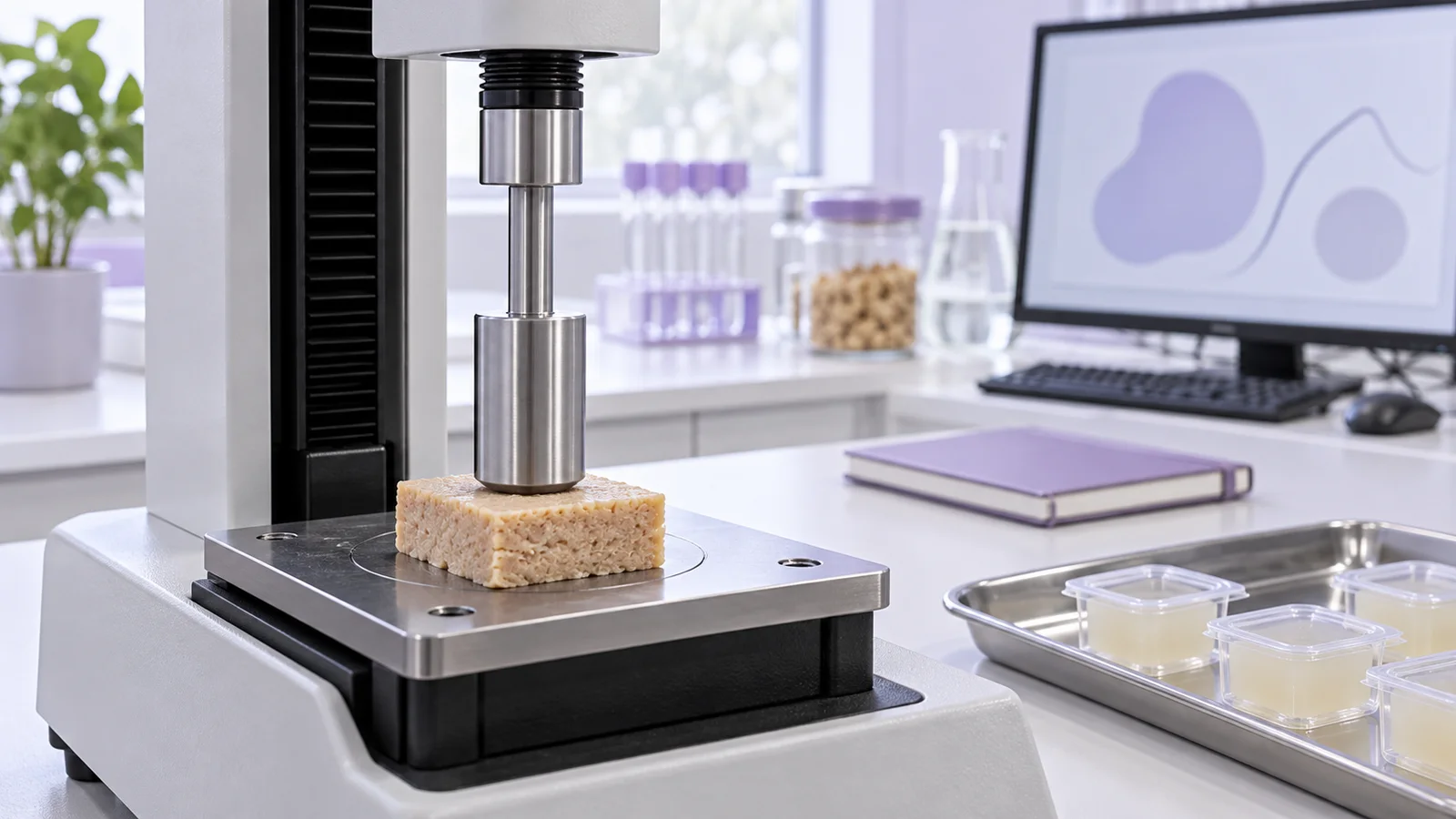
For hardness, the agent’s mean absolute error was 4.66 N; for chewiness, it was 4.45 J. Hardness represents a compression peak force, whereas chewiness represents mechanical energy. Paired bootstrap comparisons with gradient boosting gave 95% confidence intervals that included zero for both error differences, so the study could not distinguish those methods statistically on this test. The author reports significantly lower errors than pure retrieval for both targets.
A separate benchmark examined protein–polysaccharide mixtures
The second dataset concerned the rheology of plant protein–polysaccharide mixtures. The paper reports 246 training samples and 65 held-out samples, with two unusually low-stress observations excluded before predictions, leaving the same 63 evaluation samples for all methods. Its targets were storage modulus, G′, and maximum stress at 200% strain. These concern small-deformation behaviour and large-deformation behaviour, respectively.
The gel knowledge base included concentration-dependent strengthening, dilution by moisture, differences in protein gelation, protein–polysaccharide network formation and the brittleness of carrageenan-rich systems. The author emphasises that large-deformation behaviour is difficult to predict from composition features alone and that uncertainty estimates for mechanically complex targets require larger, more representative datasets.
Small datasets and expert curation remain limitations
The study queried the language model once per sample using a fixed structured prompt. In the meat-alternative comparison in Appendix Table A1, removing the mechanistic rules brought errors close to pure retrieval: hardness errors were 18.76 N without rules and 18.78 N for retrieval, compared with 4.66 N for the full agent. Chewiness errors were 15.43 J, 15.62 J and 4.45 J, respectively.
The author notes that only two tabular case studies and scalar prediction targets were examined. The agent’s quality depends on its encoded knowledge, and this implementation did not update that knowledge autonomously. New observations required manual addition. The paper calls for research on continuous learning and further tests across food systems, processing conditions and mechanical targets to establish generalisability.
-
Comparing AI agents and machine learning for predicting mechanical and rheological properties of dense food structures ↗
Current Research in Food Science · CC-BY-4.0 ↗. Yizhou Ma (2026). Comparing AI agents and machine learning for predicting mechanical and rheological properties of dense food structures. Current Research in Food Science 13, 101578. Published 21 September 2026. DOI:10.1016/j.crfs.2026.101578. Copyright The Author 2026. CC BY 4.0. Editorial adaptation and translation: FoodRadar. Adapted by FoodRadar.