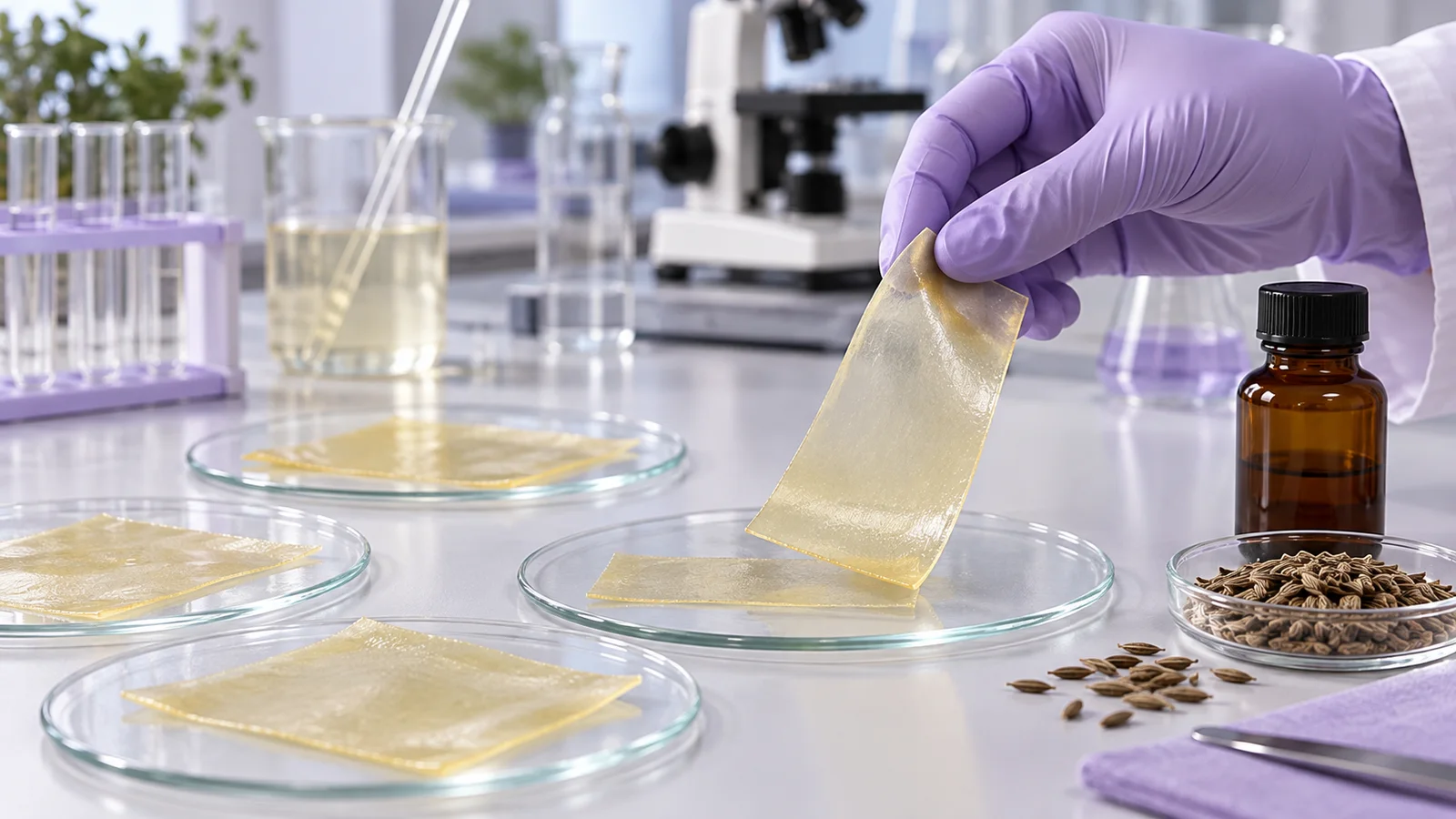
Four formulations compared nominal additive amounts
A study published in Polymers on 15 September 2026 examined cuminaldehyde, an aromatic compound associated with cumin essential oil, in gelatin/konjac glucomannan films. The control received no cuminaldehyde, while CA-1, CA-3 and CA-10 received 1, 3 and 10 mL in their respective film-forming mixtures. These were initially added amounts; the compound retained after drying was not quantified.
Each formulation used the same amount of Tween-80 emulsifier, so its ratio to cuminaldehyde decreased as loading increased. The authors acknowledge that this may have influenced dispersion and interfacial organization. Three independent film preparations were made for each formulation, with a specific exception for the descriptive contact-angle measurements.
Optical gains accompanied changes in structure and appearance
Cuminaldehyde-containing films showed lower UV transmittance than the control over the tested 200–380 nm range. Opacity did not follow one simple direction: CA-1 was less opaque than the control, whereas CA-10 was more opaque and less transparent.
FTIR, Raman, X-ray diffraction and microscopy indicated changes in local molecular environments and ordered regions. At higher loading, surfaces were more heterogeneous and cross-sections contained more voids and less compact regions. The authors treat these observations as qualitative structural support; a quantitative relationship between voids and opacity was not established.
Increasing thickness did not preserve tensile strength
Film thickness increased with loading. Tensile strength for CA-1 did not differ significantly from the control, but it was significantly lower for CA-3 and CA-10. The authors describe a trade-off between functional enhancement and structural stability.
The tensile comparison used one strip from each of three independently prepared films. Loading was manual, without a programmable crosshead speed, and the initial grip separation was not separately recorded. The source therefore emphasizes comparison within the tested conditions. Elastic modulus and Poisson’s ratio were not measured.
Surface wetting and bulk water response differed
Contact-angle observations suggested a tendency toward reduced surface wettability, but each formulation was represented by one film and one droplet at one position. The observations were descriptive and excluded from inferential statistics. Water solubility nevertheless increased, with CA-3 and CA-10 significantly above the control; swelling differences were comparatively small.
Antioxidant assays of film extracts also differed. ABTS scavenging and FRAP reducing responses generally increased with loading, while DPPH showed a nonlinear pattern, including a decrease at CA-3. The authors discuss assay mechanisms and accessibility as possible explanations rather than assigning the pattern to a single proven cause.
An intermediate option remains a candidate for further testing
The authors describe CA-3 as a possible compromise among the tested formulations. They propose narrower loading ranges to check whether that apparent compromise is reproducible, followed by real-food systems or appropriate simulants under practical storage conditions. Water-vapour permeability, water-vapour transmission and gas permeability are also identified as future measurements.
Support came from the Baise Science Research and Technology Development Plan, an experimental teaching demonstration centre for subtropical agricultural-product processing, and Guangxi First-class Disciplines in Agricultural Resources and Environment. The authors declared no conflicts of interest and state that the study’s original contributions are included in the article.
-
Effects of Cuminaldehyde on the Structural, Mechanical, UV-Barrier, and Functional Properties of Gelatin/Konjac Glucomannan Edible Films ↗
Polymers · CC-BY-4.0 ↗. Xinyun Mai, Surapon Saensouk, Piyaporn Saensouk, Xingyu Wang, Qinjiabao Hu, Lingling He, Bin Huang and Caihua Liu (2026). Effects of Cuminaldehyde on the Structural, Mechanical, UV-Barrier, and Functional Properties of Gelatin/Konjac Glucomannan Edible Films. Polymers. DOI: 10.3390/polym18182246. Copyright 2026 by the authors. Licensee MDPI, Basel, Switzerland. CC BY 4.0. Editorial adaptation and translation: FoodRadar. Adapted by FoodRadar.