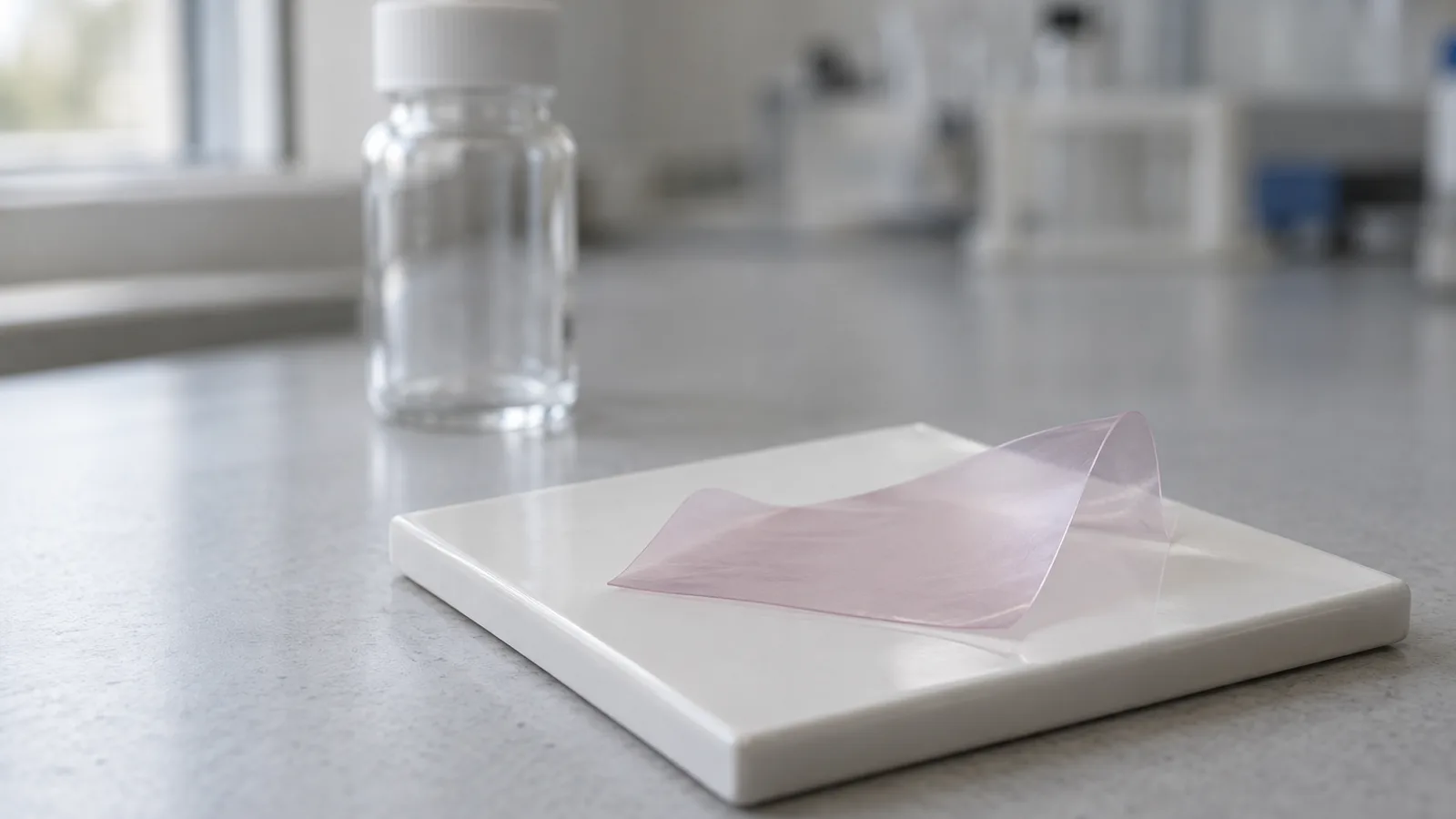
The study examines a material for indirect freshness monitoring
Gelatin films containing cobalt metal–organic frameworks changed colour during a controlled ammonia-vapour experiment in a study published in Polymers on 7 August 2026. The researchers used gallic acid as the organic ligand that helps form the cobalt framework, then incorporated the material into gelatin films.
The team compared an unfilled gelatin control with four composite formulations containing increasing amounts of the framework. It examined moisture-related, structural, optical, thermal and mechanical properties, as well as the colour response to ammonia. The authors describe the intended application as indirect freshness monitoring through ammonia sensing. Experiments were reported as at least triplicate unless otherwise stated.
The composites developed larger colour differences than the control
The films were exposed to ammonia vapour in sealed measurement containers. A colorimeter recorded colour difference, expressed as ΔE, over 120 minutes. A higher ΔE indicates a larger change from the reference colour.
After 120 minutes, the control remained below a colour difference of 1, while the four composites reached approximately 12, 15, 24 and 27 in order of increasing filler level. The formulations with more framework material responded faster and produced stronger colour changes under the tested conditions.
Water solubility and vapour permeability increased
Solubility increased from 39.09% in the unfilled control to 48.88% in the highest-filled sample. Water-vapour permeability rose from 1.652 to 2.054 g·mm/(m²·h·kPa) between those samples. The authors describe the higher permeability as a limitation for a conventional moisture barrier, while discussing its possible contribution to ammonia access.
Moisture content was lower in the composites than in the control. Swelling varied among formulations rather than falling continuously as more filler was added. The study also used moisture-sorption models to describe the films’ water uptake.
Higher filler levels reduced mechanical strength
Tensile strength was 59.47 MPa in the gelatin control and 37.72 MPa in the highest-filled formulation. Puncture force fell from 18.03 to 10.19 N between those samples. Elongation at break did not change significantly in the reported comparison.
Microscopy showed localized aggregation at higher filler levels. The authors discuss particle dispersion and polymer–filler interactions as explanations for the changing properties. They identify the sample labelled G/Co–MOF7.5 as their preferred balance of mechanical, barrier and sensing performance.
Sensor performance and food-contact safety need further assessment
The authors state that detection limit, analytical sensitivity, selectivity toward other volatile compounds and interference effects were not evaluated. They call for these measurements before practical use as ammonia indicators in commercial food packaging.
The films are intended for indirect monitoring. The authors require further migration and safety evaluation before direct food-contact applications are considered. The work received support from Bursa Technical University and European research funding. They disclosed that co-author Furkan Turker Saricaoglu was employed by Furya Nanofiber Food R&D Engineering Project Consultancy Industrial Trade Company.
-
Ammonia-Responsive Gelatin/Co–MOF Composite Films Based on Gallic Acid-Derived Metal–Organic Frameworks for Intelligent Food Packaging ↗
Polymers · CC-BY-4.0 ↗. Mahmut Ekrem Parlak, Burcu Demirtaş, Ayse Neslihan Dundar, Oya Irmak Sahin, Adnan Fatih Dagdelen, Furkan Turker Saricaoglu, Luca Rastrelli, Maria D’Elia, Sadettin Turhan and Anita Ioana Visan (2026). Ammonia-Responsive Gelatin/Co–MOF Composite Films Based on Gallic Acid-Derived Metal–Organic Frameworks for Intelligent Food Packaging. Polymers 18(16):1938. DOI: 10.3390/polym18161938. © 2026 by the authors. CC BY 4.0. Edited and translated by FoodRadar. Adapted by FoodRadar.